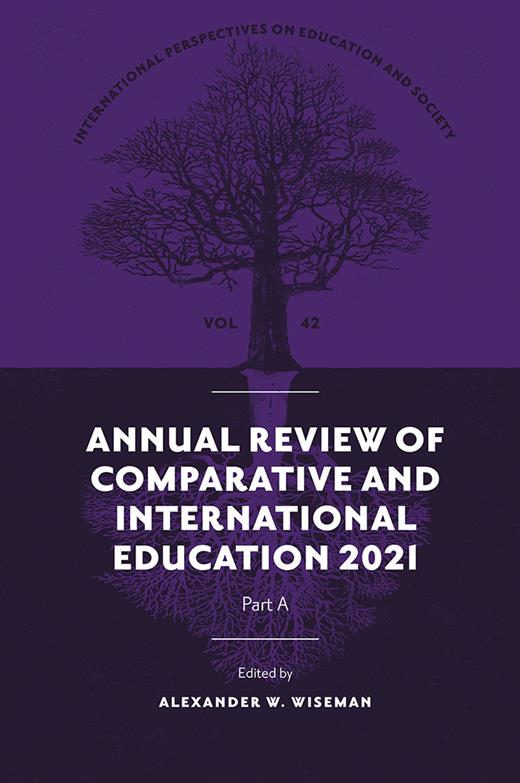
Decolonization of Education Research, Policy-making, and Practice in Central Asia: The Case of Tajikistan

By Sarfaroz Niyozov and Stephen A. Bahry

This chapter in Annual Review of Comparative and International Education 2021 reviews the challenges facing educational research and knowledge production, in the independent post-Soviet Central Asia through examination of the case of Tajikistan.

The chapter revisits issues discussed in Niyozov and Bahry (2006) on the need for research-based approaches to with these challenges, taking up Tlostanova’s (2015) challenge to see Central Asian educational history as repeated intellectual colonization, decolonization, and recolonization leading her to question whether Central Asians can think, or must simply accept policies and practices that travel from elsewhere. The authors respond by reviewing Tajikistan as representative in many aspects, if not all particulars, of the entire region. Part one of the review describes data sources, analyses, and our positionalities. Part two reviews decolonization in comparative, international, and development education and in post-Soviet education. Part three describes education research and knowledge production types and their key features. Thereafter, the authors discuss additional challenges facing Tajikistan’s and the region’s knowledge production and link them to the possibilities of decolonization discourse.

The authors conclude by suggesting realistic steps the country’s scholars and their comparative international education colleagues may take to move toward developing both research capacity and decolonization of knowledge pursuits in Tajikistan and Central Asia.

Read this chapter here.

Nations and Post-Colonialism in Central Asia: Twenty Years Later

By Sergei Abashin

The collapse of the USSR and the appearance instead of some 15 new states, not counting several territories declaring themselves to be states, has raised the inevitable question of how this space might now be reconfigured for analytical purposes. Should it, as used to be the case, be considered as an indivisible whole (as post-Soviet countries for example, or as Eurasia)? Or would it be better divided into separate parts, each correlated with other, wider delineations (North/South, West/East, the Christian/Islamic worlds etc.)? Both solutions have their reasons and goals, and, naturally, their pros and cons. In the first case, there is the risk of ascribing certain unique and uniform features to this space, while ignoring, on the one hand, its internal complexity and, on the other, its interaction with the rest of the world. In the second case, the opposite danger arises: of ignoring shared historical experiences and essentializing the borders, first and foremost the cultural borders, between the various communities that inhabit the space in question. Evidently, then, any strategy for analysis must be developed around the possibility of combining and aligning these two perspectives.

In this chapter, Abashin analyzes the new Central Asian states through the lens of three categories: nation, post-coloniality, and post-Sovietness. These terms are studied in how they are used to describe societies of Central Asia as well as models, similarities and differences, and what further questions these classifications prompt.

Read this chapter here.

Australia: Tainted Blood—Scientific Racism, Eugenics and Sanctimonious Treatments of Aboriginal Australians: 1869–2008

By Greg Blyton 

The Eugenics movement that emerged in England in the latter half of the nineteenth century was a continuance of European scientific racism sustained by a flotilla of political and academic ignorance that defined human credibility by hereditary traits, including colour and race. The movement may be defined as a European intellectual promotion to scientifically improve western societies through state systems that regulated human reproduction. In Australia, the foundations of the eugenics movement were heavily influenced by two former Cambridge University students, English scientists, Sir Francis Galton (1822–1911) and Charles Robert Darwin (1809–1882). It was a case of intellectual imperialism with colonial policymakers in Australia willingly adopting eugenics ideologies from their two English tutors. However, it would be unfair to blame a single man for the sanctimonious ways his concepts and theories were applied in policy and practice in relation to the treatment of Aboriginal Australians by Australian federal and state governments.

Read the full chapter here.

Decolonizing ‘the field’ in the anthropology of Central Asia: ‘Being there’ and ‘being here’

By Alima Bissenova

This chapter is written in the spirit of contributing to the decolonization of Central Asian anthropology. Drawing on an analysis of the works of the Russian orientalist, Aleksei Levshin (1798-1879), and his Kazakh critic, Chokan Valikhanov (1835-1865), it analyses historical practices of ‘entry into the field’, ‘being in the field’, and publication of the results, i.e., ‘descriptions and stories of the field’, in the West and Russia before the so-called ‘reflexive’ and ‘postcolonial turns’. It examines what Clifford Geertz terms the ‘gap between engaging others where they are and representing them where they are not,’ and discuss how this gap continues to inflect the anthropology of Central Asia today.

Read the full chapter here.

Mapping Mental Well-Being in India Initial Reflections on the Role of Psychiatric Spaces

By Clément Bayetti, Sushrut Jadhav and Sumeet Jain

This paper explores how two different sites—a psychiatric department and a community mental health programme embedded in a district hospital in India—construct their own peculiar understanding of mental well-being and recovery. Focusing initially on the nature of the discourse and practice emerging from a psychiatry department, this article demonstrates how members of the psychiatric profession in India are socialised into a conception of well-being narrowly defined by an absence of symptoms. It highlights how such notions emerge from the intersection existing between global paradigms such as “evidence-based medicine” and psychiatry’s “technological paradigm”. The authors argue that such conceptions of well-being can in turn be considered as both the articulation and operationalisation of a neoliberal capitalist ideology in which the hospital turns into a socially credited market where people’s “broken minds” can be fixed through the administration of psychotropic drugs, and through which recovery is narrowly conceptualised as paid employment. While such understanding may increasingly appears to fulfil the expectations of various social classes within Indian society by providing them a gateway to a form of global citizenship, this paper also shows how such notions feed into a state sponsored agenda of cost cutting public health care resources, thus impacting upon the well-being of both patients and professionals. This analysis also traces the ways in which this medicalised understanding of well-being evolves as these constructions of well-being diffuse out into wider society and become embedded into the national community mental health programme. In doing so, the paper explores ways in which such understanding may be reappropriated by people suffering from mental ill health and their communities, and the role that this plays in their personal and collective recovery.

Read the chapter here,

The gay guru

Fallibility, unworldliness, and the scene of instruction

By Lawrence Cohen

This chapter of The Guru in South Asia describes guru as an ideal type in the understanding of an emergent historical situation, and reviews ancient story of Ekalavya and some of its recent glosses. Ekalavya is refused the legitimacy of studying under the greatest teacher of his age: he responds by retreating into the forest and creating an image or copy of the teacher, toward which he directs his discipline and respect. Ekalavya journeys to Hastinapura to join the boys learning the great martial art of archery from Drona. The story of Ekalavya concludes with a different exemplar of the total gift to the guru, the guru-dakshina, than that will be demanded of Aijuna. The gurukul princes and Drona are wandering close to where Ekalavya practices. The chapter discusses the vexed relation of several modern Hindu gurus to the accusation and promise of homosexuality. Baba Ramdev’s challenge is to homosexuality as a particular kind of promise emergent with late twentieth-century Indian neoliberalism and its global milieu.

Read the full chapter here.

Generation Q and Decolonizing Alash

In The Kazakh Spring.

By Diana T. Kudaibergen

This chapter dwells further on the collective solidarity and imagined digital community that the Kazakh Spring was able to bring about. In this chapter, Kudaiberger discusses the use of language, colonial heritage, and the rethinking of its legacy in the context of the nationalizing regime of Nazarbayev. She argues that the constructed divide between the Kazakh- and Russian-speaking political audiences no longer works as a divide for the Kazakh Spring activists, who are actively embracing bilingualism not as an unattainable aspiration but as a living reality of post-independence. Kazakh Spring activists can also be dubbed the ‘Generation Q’ as they strive to return to the Latinization of the Kazakh/Qazaq language. Furthermore, this chapter discusses how activists read the decolonial theory and use it in their activism. The author dwells on why the main slogans, names, and titles of their projects come from the oeuvre of the Kazakh pre-Soviet movement of Alash and its writers and how these well-known discourses are changed and adapted to the contemporary Qazaq realities. She finally explores how the Kazakh Spring as a field allows the rethinking of the nationalistic stigma that remained a Soviet legacy.

Access this chapter here.

‘When spider webs unite they can tie up a lion´

Anti-racism, decolonial options and theories from the South

By Amber Murrey

This chapter focuses on two discrete but interrelated intellectual projects: Southern theory and decolonial options. With a focus on race-aware and anti-racist critiques of Southern theories, Murrey argues that assertions of the need to focus more centrally on Southern theory are not equivalent with assertions of the need to end, unequivocally, the coloniality of knowledge. Some of the critical and celebrated scholarship critiquing the (ongoing) hegemony of Eurocentric theory and knowing – broadly, theories from the South – has failed to systematically engage with the racialisation of actors within the university and racial inequality in knowledge making. In such paradigms, Southern theories are importantly recognised as valuable for shifting the gaze while, at the same time, there remains a certain blindness to the colonial racial hierarchies that create and sustain the invisibilisation(s) and destructions of them. Situated in the context of coloniality, such projects risk reiterating the global knowledge hierarchy. Murrey sketches an alternative: a feminist decolonial orientation founded on an open assessment of racial and geographical inequalities within the university along with a critical feminist attention to the politics of the mundane in the academy (authorship, citation, language, promotion and impromptu encounters in classrooms and corridors).

Read more here.

Create a website or blog at WordPress.com

Up ↑