Reproductive Politics and the Making of Modern India

By Mythheli Sreenivas

Beginning in the late nineteenth century, India played a pivotal role in global conversations about population and reproduction. In Reproductive Politics and the Making of Modern India, Mytheli Sreenivas demonstrates how colonial administrators, postcolonial development experts, nationalists, eugenicists, feminists, and family planners all aimed to reform reproduction to transform both individual bodies and the body politic. Across the political spectrum, people insisted that regulating reproduction was necessary and that limiting the population was essential to economic development. This book investigates the often devastating implications of this logic, which demonised some women’s reproduction as the cause of national and planetary catastrophe.

To tell this story, Sreenivas explores debates about marriage, family, and contraception. She also demonstrates how concerns about reproduction surfaced within a range of political questions-about poverty and crises of subsistence, migration and claims of national sovereignty, normative heterosexuality and drives for economic development. Locating India at the center of transnational historical change, this book suggests that Indian developments produced the very grounds over which reproduction was called into question in the modern world.

Read the book here.

The Politics of Essential Drugs: The Makings of a Successful Health Strategy: Lessons from Bangladesh.

By Zafrullah Chowdhury

When a country adopts an essential drugs list, bans ineffective and harmful pharmaceuticals and endeavours to boost local drugs production, it incites the wrath of the global drugs industry. This book tells the story of how Bangladesh, after introducing its National Drugs Policy in 1982, had to withstand a concerted campaign by transnational companies, their governments, and large sections of the medical profession. It assesses the achievements and the limitations of the Bangladeshi experiment, describes reform attempts in other countries, and provides evidence of malpractice and corruption in the pharmaceutical industry. The ambiguous role of the World Health Organization is particularly examined. The book ends with an assessment of the prospects for Bangladesh’s drugs policy in the 1990s, when it is clear that the battle for a health policy to benefit the poor has yet to be won.

Read the book here.

“Nomadity of Being” in Central Asia: Narratives of Kyrgyzstani Women’s Rights Activists

By Syinat Sultanalieva

This book offers a new framework for understanding feminism and political activism in Kyrgyzstan, “nomadity of being. ” Here, foreign information and requirements, even forced ones, are transformed into an amalgamation of the new and the old, alien and native—like kurak, a quilted patchwork blanket, made from scraps. Conceptualizing feminist narratives in Kyrgyzstan, while keeping in mind, the complex relationship between ideological borrowing, actualization, appropriation or self-colonization of “feminist” concepts can expand both scholarly and activist understanding of specificities of post-Soviet feminisms from a historiographic point of view. Kurak-feminism is feminism that is half-donor-commissioned, half-learned through interactions (personal, media, academic, professional), unashamed of its borrowed nature and working toward its own purpose that is being developed as the blanket is being quilted. Weaving in elements from completely different and, to a Western eye, incompatible approaches nomadity of being might pave the way toward a Central Asian reframing of non-Western feminisms. This provocative text will interest scholars of European politics, the post-Soviet sphere, and feminists.

Read the book here.

No Aging In India: Alzheimer’s, The Bad Family, and Other Modern Things.

By Lawrence Cohen

From the opening sequence, in which mid-nineteenth-century Indian fishermen hear the possibility of redemption in an old woman’s madness, No Aging in India captures the reader with its interplay of story and analysis. Drawing on more than a decade of ethnographic work, Lawrence Cohen links a detailed investigation of mind and body in old age in four neighborhoods of the Indian city of Varanasi (Banaras) with events and processes around India and around the world. This compelling exploration of senility—encompassing not only the aging body but also larger cultural anxieties—combines insights from medical anthropology, psychoanalysis, and postcolonial studies. Bridging literary genres as well as geographic spaces, Cohen responds to what he sees as the impoverishment of both North American and Indian gerontologies—the one mired in ambivalence toward demented old bodies, the other insistent on a dubious morality tale of modern families breaking up and abandoning their elderly. He shifts our attention irresistibly toward how old age comes to matter in the constitution of societies and their narratives of identity and history.

Read the book here.

The gay guru

Fallibility, unworldliness, and the scene of instruction

By Lawrence Cohen

This chapter of The Guru in South Asia describes guru as an ideal type in the understanding of an emergent historical situation, and reviews ancient story of Ekalavya and some of its recent glosses. Ekalavya is refused the legitimacy of studying under the greatest teacher of his age: he responds by retreating into the forest and creating an image or copy of the teacher, toward which he directs his discipline and respect. Ekalavya journeys to Hastinapura to join the boys learning the great martial art of archery from Drona. The story of Ekalavya concludes with a different exemplar of the total gift to the guru, the guru-dakshina, than that will be demanded of Aijuna. The gurukul princes and Drona are wandering close to where Ekalavya practices. The chapter discusses the vexed relation of several modern Hindu gurus to the accusation and promise of homosexuality. Baba Ramdev’s challenge is to homosexuality as a particular kind of promise emergent with late twentieth-century Indian neoliberalism and its global milieu.

Read the full chapter here.

Generation Q and Decolonizing Alash

In The Kazakh Spring.

By Diana T. Kudaibergen

This chapter dwells further on the collective solidarity and imagined digital community that the Kazakh Spring was able to bring about. In this chapter, Kudaiberger discusses the use of language, colonial heritage, and the rethinking of its legacy in the context of the nationalizing regime of Nazarbayev. She argues that the constructed divide between the Kazakh- and Russian-speaking political audiences no longer works as a divide for the Kazakh Spring activists, who are actively embracing bilingualism not as an unattainable aspiration but as a living reality of post-independence. Kazakh Spring activists can also be dubbed the ‘Generation Q’ as they strive to return to the Latinization of the Kazakh/Qazaq language. Furthermore, this chapter discusses how activists read the decolonial theory and use it in their activism. The author dwells on why the main slogans, names, and titles of their projects come from the oeuvre of the Kazakh pre-Soviet movement of Alash and its writers and how these well-known discourses are changed and adapted to the contemporary Qazaq realities. She finally explores how the Kazakh Spring as a field allows the rethinking of the nationalistic stigma that remained a Soviet legacy.

Access this chapter here.

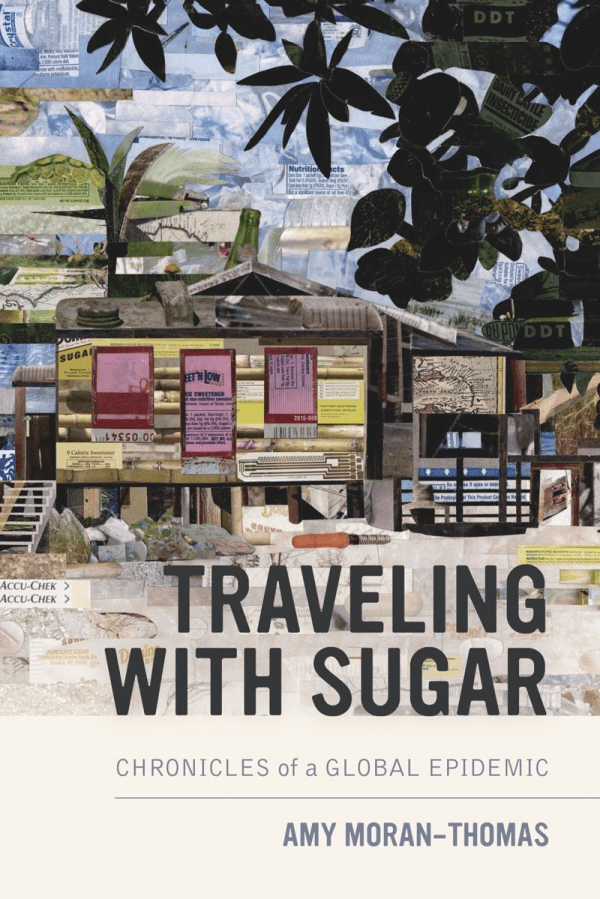
Traveling with Sugar: Chronicles of a Global Epidemic

By Amy Moran-Thomas

Traveling with Sugar reframes the rising diabetes epidemic as part of a five-hundred-year-old global history of sweetness and power. Amid eerie injuries, changing bodies, amputated limbs, and untimely deaths, many people across the Caribbean and Central America simply call the affliction “sugar” -or, as some say in Belize, “traveling with sugar.” A decade in the making, this book unfolds as a series of crónicas -a word meaning both slow-moving story and slow-moving disease. It profiles the careful work of those “still fighting it” as they grapple with unequal material infrastructures and unsettling dilemmas. Facing a new incarnation of blood sugar, these individuals speak back to science and policy misrecognitions that have prematurely cast their lost limbs and deaths as normal. Their families’ arts of maintenance and repair illuminate ongoing struggles to survive and remake larger systems of food, land, technology, and medicine.

Read the book here.

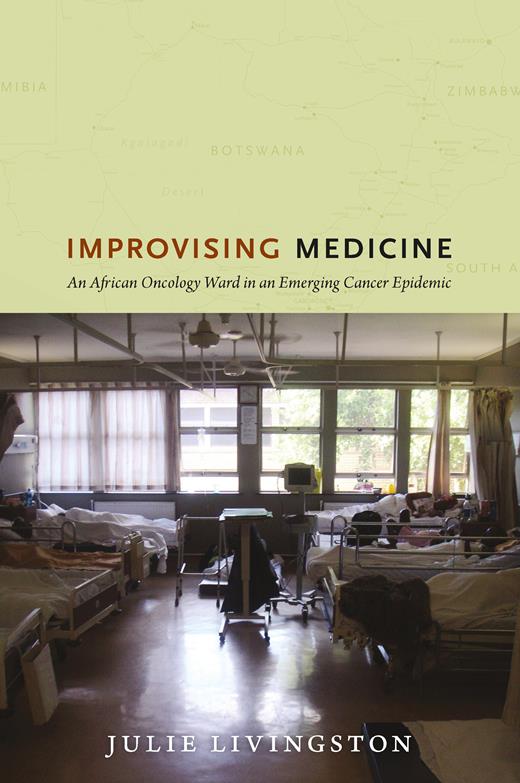
Improvising Medicine: An African Oncology Ward in an Emerging Cancer Epidemic

By Julie Livingston

In Improvising Medicine, Livingston tells the story of Botswana’s only dedicated cancer ward, located in its capital city of Gaborone. This affecting ethnography follows patients, their relatives, and ward staff as a cancer epidemic emerged in Botswana. The epidemic is part of an ongoing surge in cancers across the Global South; the stories of Botswana’s oncology ward dramatize the human stakes and intellectual and institutional challenges of an epidemic that will shape the future of global health. They convey the contingencies of high-tech medicine in a hospital where vital machines are often broken, drugs go in and out of stock, and bed-space is always at a premium. They also reveal cancer as something that happens between people. Serious illness, care, pain, disfigurement, and even death emerge as deeply social experiences. Livingston describes the cancer ward in terms of the bureaucracy, vulnerability, power, biomedical science, mortality, and hope that shape contemporary experience in southern Africa. Her ethnography is a profound reflection on the social orchestration of hope and futility in an African hospital, the politics and economics of healthcare in Africa, and palliation and disfigurement across the Global South.

Read the book here.

The Inconstancy of the Indian Soul

The Encounter of Catholics and Cannibals in 16-century Brazil

By Eduardo Viveiros de Castro

In the mid-sixteenth century, Jesuit missionaries working in what is now Brazil were struck by what they called the inconstancy of the people they met, the indigenous Tupi-speaking tribes of the Atlantic coast. Though the Indians appeared eager to receive the Gospel, they also had a tendency to forget the missionaries’ lessons and “revert” to their natural state of war, cannibalism, and polygamy. This peculiar mixture of acceptance and rejection, compulsion and forgetfulness was incorrectly understood by the priests as a sign of the natives’ incapacity to believe in anything durably.

In this pamphlet, world-renowned Brazilian anthropologist Eduardo Viveiros de Castro situates the Jesuit missionaries’ accounts of the Tupi people in historical perspective, and in the process draws out some startling and insightful implications of their perceived inconstancy in relation to anthropological debates on culture and religion.

Access the book here.

All That Was Not Her

By Todd Meyers

While studying caregiving and chronic illness in families living in situations of economic and social insecurity in Baltimore, anthropologist Todd Meyers met a woman named Beverly. In All That Was Not Her Meyers presents an intimate ethnographic portrait of Beverly, stitching together small moments they shared scattered over months and years and, following her death, into the present. He meditates on the possibilities of writing about someone who is gone – what should be represented, what experiences resist rendering, what ethical challenges exist when studying the lives of others. Meyers considers how chronic illness is bound up in the racialized and socioeconomic conditions of Beverly’s life and explores the stakes of the anthropologist’s engagement with one subject. Even as Meyers struggles to give Beverly the final word, he finds himself unmade alongside her. All That Was Not Her captures the complexity of personal relationships in the field and the difficulty of their ending.

Read the book here.

Create a website or blog at WordPress.com

Up ↑