Our Collections

Arts and Humanities for Good Public Health Webinar

Hosted by the London School of Hygiene & Tropical Medicine

In partnership with the UK Faculty of Public Health, the London School of Hygiene & Tropical Medicine hosted a roundtable addressing the importance of the arts and humanities within public health education and training in January 2024.

Watch the full recording here.

Nations and Post-Colonialism in Central Asia: Twenty Years Later

By Sergei Abashin

The collapse of the USSR and the appearance instead of some 15 new states, not counting several territories declaring themselves to be states, has raised the inevitable question of how this space might now be reconfigured for analytical purposes. Should it, as used to be the case, be considered as an indivisible whole (as post-Soviet countries for example, or as Eurasia)? Or would it be better divided into separate parts, each correlated with other, wider delineations (North/South, West/East, the Christian/Islamic worlds etc.)? Both solutions have their reasons and goals, and, naturally, their pros and cons. In the first case, there is the risk of ascribing certain unique and uniform features to this space, while ignoring, on the one hand, its internal complexity and, on the other, its interaction with the rest of the world. In the second case, the opposite danger arises: of ignoring shared historical experiences and essentializing the borders, first and foremost the cultural borders, between the various communities that inhabit the space in question. Evidently, then, any strategy for analysis must be developed around the possibility of combining and aligning these two perspectives.

In this chapter, Abashin analyzes the new Central Asian states through the lens of three categories: nation, post-coloniality, and post-Sovietness. These terms are studied in how they are used to describe societies of Central Asia as well as models, similarities and differences, and what further questions these classifications prompt.

Read this chapter here.

Humoural Concepts of Mental Illness in India

By Sushrut Jadhav

Based on interviews with patients at three allopathic psychiatric clinics in Bombay, Bangalore and Varanasi to elicit indigenous explanations of illness and patterns of prior help seeking, the paper discusses popular humoral theories of mental disorder. Even though most laypersons are unfamiliar with the content of the classical treatises of Ayurveda, the humoral traditions which they represent influence current perceptions. Case vignettes clarify the nature of the relationship between cultural, familial and personal factors that influence the experience of illness.

Read the article here.

Decolonial Keywords: South Asian Thoughts and Attitudes

By Renny Thomas and Sasanka Perera

This volume presents a set of keywords and concepts anchored in the region’s languages and its vast cultural landscape. It reiterates specific attitudes, ways of seeing and methods of doing, embedded in the historical and contemporary experiences in South Asia. The words, concepts, ideas, and attitudes in this volume explore the contexts of their production and how their meanings have changed at different historical moments. Individual essays, from across disciplines, argues for the importance in moving away from the intellectual shackles of colonial and neo-colonial experiences while also not succumbing to the traps of local reductionist nativisms and cultural nationalisms.

Find further information here.

Walking Away Diabetes in the Tropics: A Reflection

By Mohammad Bin Khidzer

This short memo is based on the authors short field trips in Jogjakarta and Singapore in June and July 2025. It examines whether walking can prevent type 2 diabetes in tropical cities. Drawing on fieldwork in Singapore and Jogjakarta, the author shows how climate, infrastructure and socioeconomic inequality shape people’s ability to walk. While Singapore’s shaded walkways and transport network allow for active mobility, Jogjakarta’s heat, traffic and lack of pavements make walking difficult. The author demonstrates that in hot, humid contexts, “walking for health” depends on urban design and environment, and that for low-income diabetics facing food and medication insecurity, walking alone is not sufficient. The essay calls for diabetes-prevention strategies that integrate climate, infrastructure and inequality.

Read the full memo here.

The Political Stakes of Cancer Epistemics

By Shagufta Bhangu, Violeta Argudo-Portal, Luiz Alves Araújo Neto, Thandeka Cochrane, Masha Denisova, Nickolas Surawy-Stepney.

The authors demonstrate a transnationally situated dialogue as a method to bring ethnographic and historical research in Brazil, East Africa (Kenya, Tanzania and Uganda), India, Russia and Spain into conversation to show three cancer epistemics sites (research, detection, and care access) where the politics of cancer epistemics are at play. First, in the field of research, they show how certain ways of knowing, and certain questions about and interests in cancer, are privileged over others. Using examples from Spain and East Africa, they highlight how a shift towards microbiological and high-technology research has outpriced many more locally grounded research agendas, ignoring questions of industrial and capital accountability in cancer aetiology. Second, they look at ways of making cancer visible, how knowledge is mobilised in cancer detection and screening, where and for whom. The authors discuss the increased individualisation of risk which is reframing cancer surveillance and therapeutic agendas. Using examples from India, Spain and Brazil, the authors demonstrate how the epistemics of cancer detection generate discourses of blame and responsibility at the individual level and accentuate existing inequities whilst simultaneously absorbing patients and their families into complex networks of surveillance. Lastly, they examine how the epistemics of cancer implicate the very possibilities of accessing cancer care, shaping care pathways and possibilities for patients. With ethnographic examples from India, Russia and Brazil, the authors demonstrate how an orientation towards the individual shifts attention away from the commercialisation of healthcare and dominance of logics of profit in therapeutics.

Read the article here.

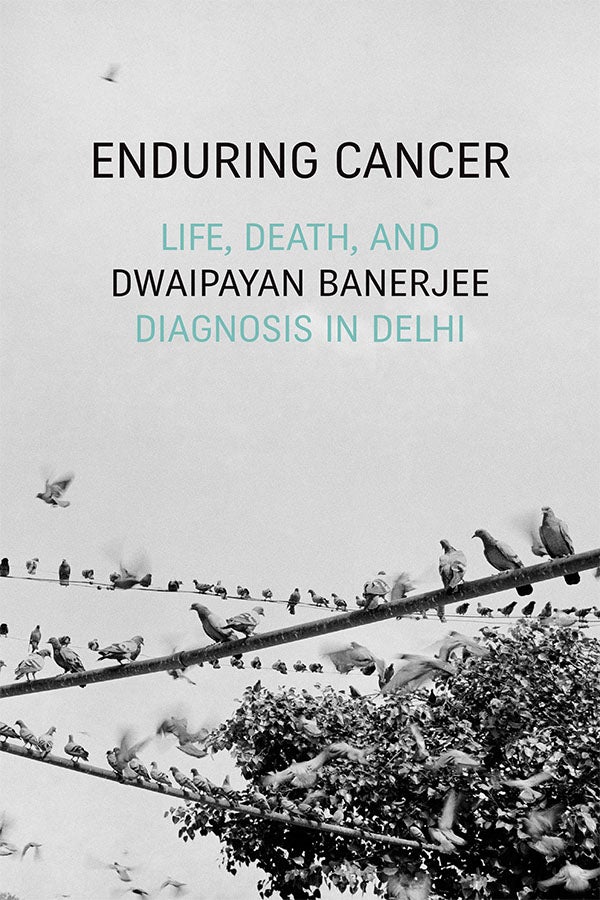
Enduring Cancer: Life, Death, and Diagnosis in Delhi

By Dwaipayan Banerjee

In Enduring Cancer Dwaipayan Banerjee explores the efforts of Delhi’s urban poor to create a livable life with cancer as patients and families negotiate an overextended health system unequipped to respond to the disease. Owing to long wait times, most urban poor cancer patients do not receive a diagnosis until it is too late to treat the disease effectively. Drawing on ethnographic fieldwork in the city’s largest cancer care NGO and at India’s premier public health hospital, Banerjee describes how, for these patients, a cancer diagnosis is often the latest and most serious in a long series of infrastructural failures. In the wake of these failures, Banerjee tracks how the disease then distributes itself across networks of social relations, testing these networks for strength and vulnerability. Banerjee demonstrates how living with and alongside cancer is to be newly awakened to the fragility of social ties, some already made brittle by past histories, and others that are retested for their capacity to support.

Read the full book here.

Developing an agenda for the decolonization of global health

By David McCoy, Anuj Kapilashrami, Ramya Kumar, Emma Rhule , Rajat Khosla

Colonialism, which involves the systemic domination of lands, markets, peoples, assets, cultures or political institutions to exploit, misappropriate and extract wealth and resources, affects health in many ways. In recent years, interest has grown in the decolonization of global health with a focus on correcting power imbalances between high-income and low-income countries and on challenging ideas and values of some wealthy countries that shape the practice of global health. The authors argue that decolonization of global health must also address the relationship between global health actors and contemporary forms of colonialism, in particular the current forms of corporate and financialized colonialism that operate through globalized systems of wealth extraction and profiteering. They present a three-part agenda for action that can be taken to decolonize global health. The first part relates to the power asymmetries that exist between global health actors from high-income and historically privileged countries and their counterparts in low-income and marginalized settings. The second part concerns the colonization of the structures and systems of global health governance itself. The third part addresses how colonialism occurs through the global health system. Addressing all forms of colonialism calls for a political and economic anticolonialism as well as social decolonization aimed at ensuring greater national, racial, cultural and knowledge diversity within the structures of global health.

Read the article here.

A History of Indigenous Australia and the University of Melbourne

By Dhoombak Goobgoowana

Dhoombak Goobgoowana can be translated as ‘truth telling’ in the Woi Wurrung language of the Wurundjeri Woi Wurrung people on whose unceded lands several University of Melbourne campuses are located.

Volume 1: Truth

This book, the first of two volumes, is an attempt to acknowledge and publicly address the long, complex and troubled relationship between the Indigenous people of what we now call the continent of Australia and the University of Melbourne.

It is a book about race and how it has been constructed by academics in the University. It is also about power and how academics have wielded it and justified its use against Indigenous populations, and about knowledge, especially the Indigenous knowledge that silently contributed to many early research projects and collection endeavours.

Although many things have changed, the stain of the past remains. But the University no longer wishes to look away.

Read Volume 1 of the book here.

Volume 2: Voice

Volume 2 reveals the pivotal role played by Indigenous people in the history of the University of Melbourne.

It traces the University’s role in ignoring and quietening Indigenous peoples’ voices, and the reverberations created by those voices that broke through. It shows how collections of art and cultural objects have transitioned from texts for western interpretation to expressions of self-identity. It reveals the Indigenous pioneers who gained admission to the University as students more than a century after it was established, and then later as staff, and documents their triumphs and struggles.

This second volume, following the revelations of Dhoombak Goobgoowana Volume I: Truth, shows how Indigenous communities challenged and disrupted the University, how they contributed to its research endeavours and exhorted it to introduce Indigenous knowledge into the academic sphere.

Imperfect, overdue and then often painfully slow, but marked by stories of courage and hope—this is what a history of inclusion looks like.

Read Volume 2 of the book here.

Aboriginal and Torres Strait Islander readers are advised that Dhoombak Goobgoowana contains images and names of people who have died. Readers are also advised that they may be disturbed by the content of this book, which includes distressing images and descriptions, and derogatory terms for Indigenous people used in their historical context.

Dark Emu

Directed by Allan Clarke

Thought provoking, revelatory and inspiring – this feature length documentary from Blackfella Films tells the story of Bruce Pascoe’s 2014 best-selling book, Dark Emu, which challenged thinking around Australian history.

It’s been said that ‘Dark Emu argues for a reconsideration of the ‘hunter-gatherer’ tag for pre-colonial Aboriginal Australians and attempts to rebut the colonial myths that have worked to justify dispossession.’

Critics at the time praised the book, Marcia Langton for the Australian wrote “This is the most important book on Australia and should be read by every Australian.”

Watch the documentary here.

Create a website or blog at WordPress.com

Up ↑