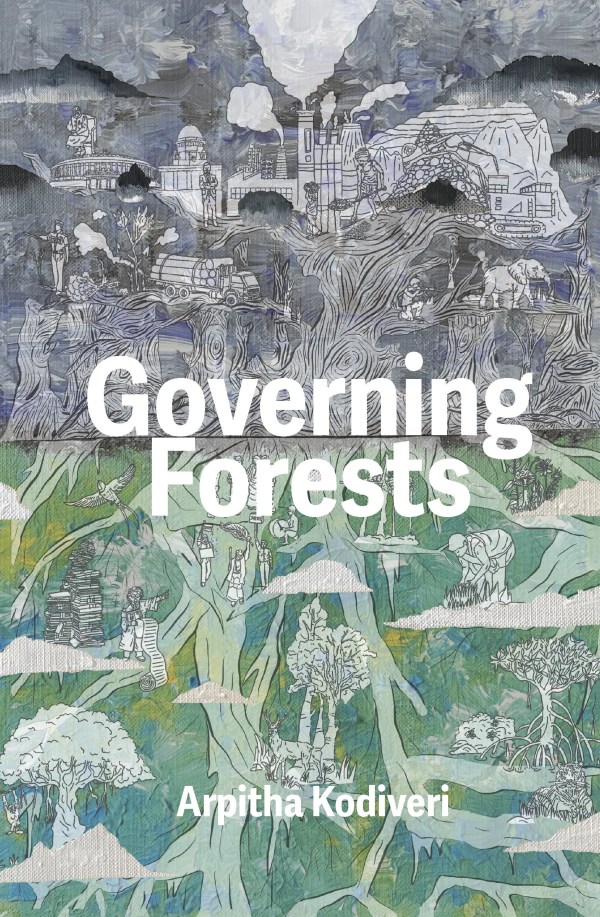
Governing Forests: State, Law and Citizenship in India’s Forests

By Arpitha Kodiveri

The nations of the Global North are responding to the climate change emergency with emissions trading schemes and alternative sources of energy. Meanwhile, nations of the Global South, still emerging from historical exploitation under colonialism, face decisions about natural resource use that are, for traditional owners and inhabitants of resource – rich lands, often a matter of life or death.

This book is the culmination of seven years immersed in the legal struggles of diverse forest-dwelling communities in India. Inspired by these social movements, Kodiveri tell the stories of how adivasi communities are using and shaping the law through clever legal interpretation and activism. The law Kodiveri shows is expanded, reframed and rendered malleable by forest-dwelling indigenous communities to be inclusive of their visions of justice, all while other laws seek to criminalize and erase their rights to land and waters.

Read the book here.

Pluriverse: A Post-Development Dictionary

Edited by Ashish Kothari, Ariel Salleh, Arturo Escobar, Federico Demaria, and Alberto Acosta

This book invites readers to join in a deep process of intellectual, emotional, ethical, and spiritual decolonization. The editors’ shared conviction is that the idea of ‘development as progress’ needs to be deconstructed to open a way for cultural alternatives that nurture and respect life on Earth. The dominant Western development model is a homogenizing construct, one that has usually been adopted by people across the world under material duress. The counter-term ‘post-development’ implies a myriad of systemic critiques and ways of living. This Dictionary is intended to re-politicize the ongoing debate over socio-ecological transformation by emphasizing its multi-dimensionality. It can be used for teaching and research; to inspire movement activists; to initiate the curious, and even those in power who no longer feel at ease with their world.

The editors are conscious of thematic and geographical gaps, but offer the book as an invitation to explore what they see as relational ‘ways of being’. This means remaking politics in a way that is deeply felt. Just so, in editing this book – as in any act of care – they themselves have encountered the limits of their own cultural reflexivity, even vulnerabilities, and in turn, discovered new understandings and acceptance. The ‘personal is political’, as feminists say. The book speaks to a worldwide confluence of economic, socio-political, cultural, and ecological visions. Each essay is written by someone who is deeply engaged with the world-view or practice described – from indigenous resisters to middle-class rebels.

The Dictionary is unconventional for its genre in having three parts. These reflect the historical transition that twenty-first century scholars and activists must work in: Development and Its Crises, Universalizing the Earth, and A People’s Pluriverse. The visions and practices contained in this Dictionary are not about applying a set of policies, instruments and indicators to exit ‘maldevelopment’. Rather, they are about recognizing the diversity of people’s views on planetary well-being and their skills in protecting it. They seek to ground human activities in the rhythms and frames of nature, respecting the interconnected materiality of all that lives. This indispensible knowledge needs to be held safe in the commons, not privatized or commodified for sale. The visions and practices offered here put buen vivir before material accumulation. They honour cooperation rather than competitiveness as the norm. They see work in pleasurable livelihoods, not ‘deadlihoods’ to escape from on weekends or ecotouristic vacations. Again, too often in the name of ‘development’, human creativity is destroyed by dull, homogenizing education systems.

They assemble this Dictionary to help in the collective search for an ecologically wise and socially just world. They envisage the book as contributing to a journey towards a Global Tapestry of Alternatives, strengthening hope and inspiration by learning from each other; strategizing advocacy and action; and building collaborative initiatives. In doing so, they do not underestimate the epistemological, political, and emotional challenges of remaking our own histories.

Read the full book here.
On Infertile Ground: Population Control and Women’s Rights in the Era of Climate Change

By Jade S. Sasser

Since the turn of the millennium, American media, scientists, and environmental activists have insisted that the global population crisis is “back” – and that the only way to avoid catastrophic climate change is to ensure women’s universal access to contraception. Did the population problem ever disappear? What is bringing it back – and why now? In On Infertile Ground, Jade S. Sasser explores how a small network of international development actors, including private donors, NGO program managers, scientists, and youth advocates, is bringing population back to the center of public environmental debate. While these narratives never disappeared, Sasser argues, histories of human rights abuses, racism, and a conservative backlash against abortion in the 1980s drove them underground – until now.

Using interviews and case studies from a wide range of sites – from Silicon Valley foundation headquarters to youth advocacy trainings, the halls of Congress and an international climate change conference – Sasser demonstrates how population growth has been reframed as an urgent source of climate crisis and a unique opportunity to support women’s sexual and reproductive health and rights. Although well-intentioned – promoting positive action, women’s empowerment, and moral accountability to a global community – these groups also perpetuate the same myths about the sexuality and lack of virtue and control of women and the people of global south that have been debunked for decades. Unless the development community recognizes the pervasive repackaging of failed narratives, Sasser argues, true change and development progress will not be possible. On Infertile Ground presents a unique critique of international development that blends the study of feminism, environmentalism, and activism in a groundbreaking way. It will make any development professional take a second look at the ideals driving their work.

Read the book here.

“Nomadity of Being” in Central Asia: Narratives of Kyrgyzstani Women’s Rights Activists

By Syinat Sultanalieva

This book offers a new framework for understanding feminism and political activism in Kyrgyzstan, “nomadity of being. ” Here, foreign information and requirements, even forced ones, are transformed into an amalgamation of the new and the old, alien and native—like kurak, a quilted patchwork blanket, made from scraps. Conceptualizing feminist narratives in Kyrgyzstan, while keeping in mind, the complex relationship between ideological borrowing, actualization, appropriation or self-colonization of “feminist” concepts can expand both scholarly and activist understanding of specificities of post-Soviet feminisms from a historiographic point of view. Kurak-feminism is feminism that is half-donor-commissioned, half-learned through interactions (personal, media, academic, professional), unashamed of its borrowed nature and working toward its own purpose that is being developed as the blanket is being quilted. Weaving in elements from completely different and, to a Western eye, incompatible approaches nomadity of being might pave the way toward a Central Asian reframing of non-Western feminisms. This provocative text will interest scholars of European politics, the post-Soviet sphere, and feminists.

Read the book here.

Generation Q and Decolonizing Alash

In The Kazakh Spring.

By Diana T. Kudaibergen

This chapter dwells further on the collective solidarity and imagined digital community that the Kazakh Spring was able to bring about. In this chapter, Kudaiberger discusses the use of language, colonial heritage, and the rethinking of its legacy in the context of the nationalizing regime of Nazarbayev. She argues that the constructed divide between the Kazakh- and Russian-speaking political audiences no longer works as a divide for the Kazakh Spring activists, who are actively embracing bilingualism not as an unattainable aspiration but as a living reality of post-independence. Kazakh Spring activists can also be dubbed the ‘Generation Q’ as they strive to return to the Latinization of the Kazakh/Qazaq language. Furthermore, this chapter discusses how activists read the decolonial theory and use it in their activism. The author dwells on why the main slogans, names, and titles of their projects come from the oeuvre of the Kazakh pre-Soviet movement of Alash and its writers and how these well-known discourses are changed and adapted to the contemporary Qazaq realities. She finally explores how the Kazakh Spring as a field allows the rethinking of the nationalistic stigma that remained a Soviet legacy.

Access this chapter here.

Ringing the Existential Alarm: Exploring BirthStrike for Climate

By Heather McMullen and Katharine Dow

Photo: Matt Palmer

Climate change is altering the horizon of a liveable future and as a result giving rise to a host of anxieties: ecological, demographic, reproductive, and existential. The BirthStrike for Climate collective was a group of people who were reconsidering reproduction as a result of the climate crisis. In exploring the case of BirthStrike we consider how these decisions were used as a tool for “existential” activism and how the campaign was encountered and discredited in the public realm. We argue the campaign ignited numerous anxieties, resulting in an inability to “hear” the existential threat BirthStrikers aimed to call into focus.

Read the full article here.

The Biopolitics of Breast Cancer: Changing Cultures of Disease and Activism

By Maren Klawiter

In this book, Klawiter analyzes the breast cancer movement to show the broad social impact of how diseases come to be medically managed and publicly administered. Examining surgical procedures, early detection campaigns, and discourses of risk, Klawiter demonstrates that these practices initially inhibited, but later enabled, collective action. The Biopolitics of Breast Cancer ultimately challenges our understanding of the origins, politics, and future of the breast cancer movement.

Read the book here.

Create a website or blog at WordPress.com

Up ↑