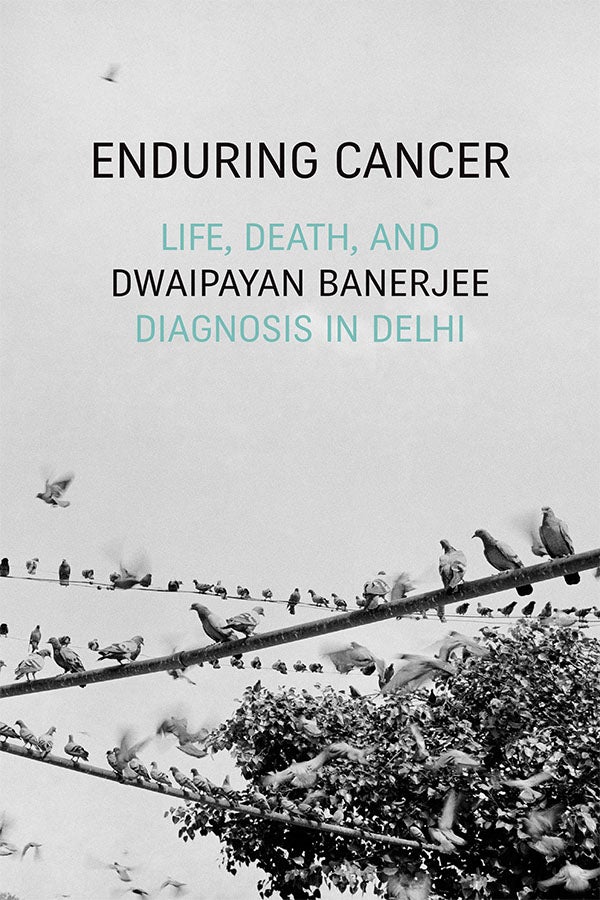
Enduring Cancer: Life, Death, and Diagnosis in Delhi

By Dwaipayan Banerjee

In Enduring Cancer Dwaipayan Banerjee explores the efforts of Delhi’s urban poor to create a livable life with cancer as patients and families negotiate an overextended health system unequipped to respond to the disease. Owing to long wait times, most urban poor cancer patients do not receive a diagnosis until it is too late to treat the disease effectively. Drawing on ethnographic fieldwork in the city’s largest cancer care NGO and at India’s premier public health hospital, Banerjee describes how, for these patients, a cancer diagnosis is often the latest and most serious in a long series of infrastructural failures. In the wake of these failures, Banerjee tracks how the disease then distributes itself across networks of social relations, testing these networks for strength and vulnerability. Banerjee demonstrates how living with and alongside cancer is to be newly awakened to the fragility of social ties, some already made brittle by past histories, and others that are retested for their capacity to support.

Read the full book here.
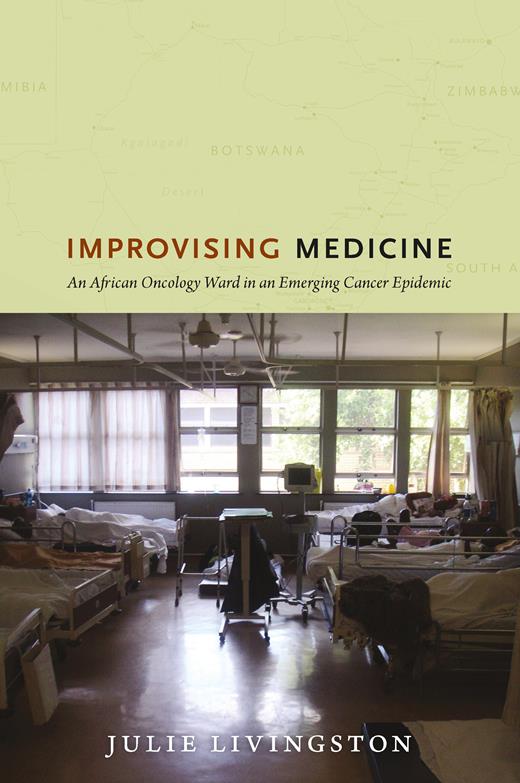
Improvising Medicine: An African Oncology Ward in an Emerging Cancer Epidemic

By Julie Livingston

In Improvising Medicine, Livingston tells the story of Botswana’s only dedicated cancer ward, located in its capital city of Gaborone. This affecting ethnography follows patients, their relatives, and ward staff as a cancer epidemic emerged in Botswana. The epidemic is part of an ongoing surge in cancers across the Global South; the stories of Botswana’s oncology ward dramatize the human stakes and intellectual and institutional challenges of an epidemic that will shape the future of global health. They convey the contingencies of high-tech medicine in a hospital where vital machines are often broken, drugs go in and out of stock, and bed-space is always at a premium. They also reveal cancer as something that happens between people. Serious illness, care, pain, disfigurement, and even death emerge as deeply social experiences. Livingston describes the cancer ward in terms of the bureaucracy, vulnerability, power, biomedical science, mortality, and hope that shape contemporary experience in southern Africa. Her ethnography is a profound reflection on the social orchestration of hope and futility in an African hospital, the politics and economics of healthcare in Africa, and palliation and disfigurement across the Global South.

Read the book here.

How Cancer Crossed the Color Line

By Keith Wailoo

Examining one hundred years in the public campaign against cancer, this path-breaking study of scientific, medical, and epidemiological writings and of cinematic and literary representations of disease, reveals how experts and the lay public saw cancer’s demographic shifts – from a stereotypical white female disease to equal opportunity killer — as a message about women, men, race and the changing color line.

Read the book here.

Chemonotes

By Harry M. Marks

Professor Harry M. Marks, faculty member in the Department of History of Medicine at Johns Hopkins University since 1989, died on 25 January 2011, aged 64. He served on the editorial board of Social History of Medicine and was a generous and exacting reviewer for the journal. As a memorial to Pr. Marks, some of his extraordinary personal reflections during his time as an outpatient undergoing treatment for prostate cancer were collated. He periodically emailed these musings to family members, friends and colleagues. At a memorial celebration held in Baltimore in February 2011, Gert Brieger observed that Harry Marks lived his life as if in a ‘perpetual teaching moment’. These emails stand in testament not only to that, but also to Marks’ rapacious intellectual curiosity, rasping critique, sense of humour, and, not least, remarkable fortitude.

Read his reflections here.

Marked Women: The Cultural Politics of Cervical Cancer in Venezuela

By Rebecca G. Martinez

Cervical cancer is the third leading cause of death among women in Venezuela, with poor and working-class women bearing the brunt of it. Doctors and public health officials regard promiscuity and poor hygiene—coded indicators for low class, low culture, and bad morals—as risk factors for the disease.

Drawing on in-depth fieldwork conducted in two oncology hospitals in Caracas, Marked Women is an ethnography of women’s experiences with cervical cancer, the doctors and nurses who treat them, and the public health officials and administrators who set up intervention programs to combat the disease. Rebecca G. Martínez contextualizes patient-doctor interactions within a historical arc of Venezuelan nationalism, modernity, neoliberalism, and Chavismo to understand the scientific, social, and political discourses surrounding the disease. The women, marked as deviant for their sexual transgressions, are not only characterized as engaging in unhygienic, uncultured, and promiscuous behaviors, but also become embodiments of these very behaviors. Ultimately, Marked Women explores how epidemiological risk is a socially, culturally, and historically embedded process—and how this enables cervical cancer to stigmatize women as socially marginal, burdens on society, and threats to the “health” of the modern nation.

Read more here.

Create a website or blog at WordPress.com

Up ↑