Decolonization of Education Research, Policy-making, and Practice in Central Asia: The Case of Tajikistan

By Sarfaroz Niyozov and Stephen A. Bahry

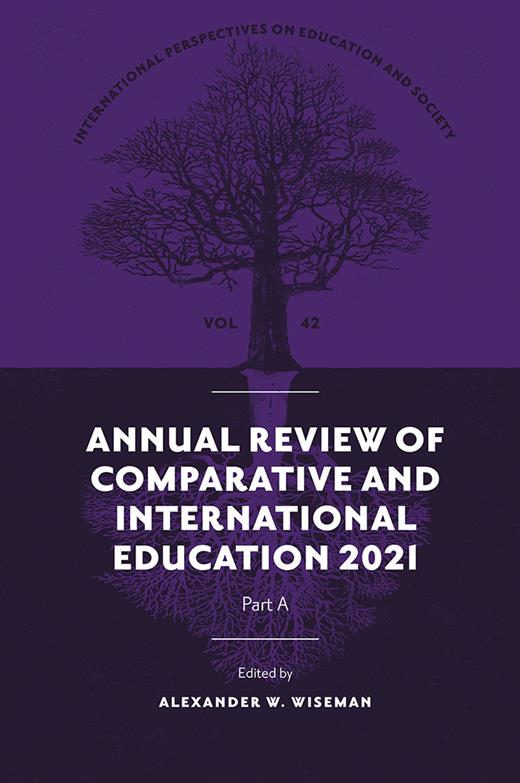
This chapter in Annual Review of Comparative and International Education 2021 reviews the challenges facing educational research and knowledge production, in the independent post-Soviet Central Asia through examination of the case of Tajikistan.

The chapter revisits issues discussed in Niyozov and Bahry (2006) on the need for research-based approaches to with these challenges, taking up Tlostanova’s (2015) challenge to see Central Asian educational history as repeated intellectual colonization, decolonization, and recolonization leading her to question whether Central Asians can think, or must simply accept policies and practices that travel from elsewhere. The authors respond by reviewing Tajikistan as representative in many aspects, if not all particulars, of the entire region. Part one of the review describes data sources, analyses, and our positionalities. Part two reviews decolonization in comparative, international, and development education and in post-Soviet education. Part three describes education research and knowledge production types and their key features. Thereafter, the authors discuss additional challenges facing Tajikistan’s and the region’s knowledge production and link them to the possibilities of decolonization discourse.

The authors conclude by suggesting realistic steps the country’s scholars and their comparative international education colleagues may take to move toward developing both research capacity and decolonization of knowledge pursuits in Tajikistan and Central Asia.

Read this chapter here.

Nations and Post-Colonialism in Central Asia: Twenty Years Later

By Sergei Abashin

The collapse of the USSR and the appearance instead of some 15 new states, not counting several territories declaring themselves to be states, has raised the inevitable question of how this space might now be reconfigured for analytical purposes. Should it, as used to be the case, be considered as an indivisible whole (as post-Soviet countries for example, or as Eurasia)? Or would it be better divided into separate parts, each correlated with other, wider delineations (North/South, West/East, the Christian/Islamic worlds etc.)? Both solutions have their reasons and goals, and, naturally, their pros and cons. In the first case, there is the risk of ascribing certain unique and uniform features to this space, while ignoring, on the one hand, its internal complexity and, on the other, its interaction with the rest of the world. In the second case, the opposite danger arises: of ignoring shared historical experiences and essentializing the borders, first and foremost the cultural borders, between the various communities that inhabit the space in question. Evidently, then, any strategy for analysis must be developed around the possibility of combining and aligning these two perspectives.

In this chapter, Abashin analyzes the new Central Asian states through the lens of three categories: nation, post-coloniality, and post-Sovietness. These terms are studied in how they are used to describe societies of Central Asia as well as models, similarities and differences, and what further questions these classifications prompt.

Read this chapter here.

Decolonizing ‘the field’ in the anthropology of Central Asia: ‘Being there’ and ‘being here’

By Alima Bissenova

This chapter is written in the spirit of contributing to the decolonization of Central Asian anthropology. Drawing on an analysis of the works of the Russian orientalist, Aleksei Levshin (1798-1879), and his Kazakh critic, Chokan Valikhanov (1835-1865), it analyses historical practices of ‘entry into the field’, ‘being in the field’, and publication of the results, i.e., ‘descriptions and stories of the field’, in the West and Russia before the so-called ‘reflexive’ and ‘postcolonial turns’. It examines what Clifford Geertz terms the ‘gap between engaging others where they are and representing them where they are not,’ and discuss how this gap continues to inflect the anthropology of Central Asia today.

Read the full chapter here.

Decolonisation of Education Research, Policy-making, and Practice in Central Asia: The Case of Tajikistan

By Sarfaroz Niyozov and Stephen A. Bahry 

This chapter reviews the challenges facing educational research and knowledge production, in the independent post-Soviet Central Asia through examination of the case of Tajikistan. The chapter revisits issues discussed in Niyozov and Bahry (2006) on the need for research-based approaches to with these challenges, taking up Tlostanova’s (2015) challenge to see Central Asian educational history as repeated intellectual colonization, decolonization, and recolonization leading her to question whether Central Asians can think, or must simply accept policies and practices that travel from elsewhere. The authors respond by reviewing Tajikistan as representative in many aspects, if not all particulars, of the entire region. Part one of the review describes data sources, analyses, and our positionalities. Part two reviews decolonisation in comparative, international, and development education and in post-Soviet education. Part three describes education research and knowledge production types and their key features. Thereafter, the authors discuss additional challenges facing Tajikistan’s and the region’s knowledge production and link them to the possibilities of decolonisation discourse. The authors conclude by suggesting realistic steps the country’s scholars and their comparative international education colleagues may take to move toward developing both research capacity and decolonisation of knowledge pursuits in Tajikistan and Central Asia.

Read the article here.

Create a website or blog at WordPress.com

Up ↑