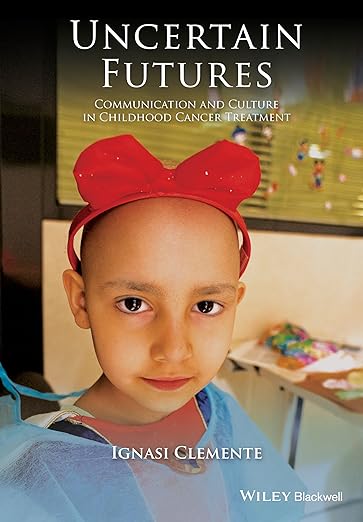
Uncertain Futures: Communication and Culture in Childhood Cancer Treatment

By Ignasi Clemente

This book examines children and young people’s attempts to participate in conversations about their own treatment throughout uncertain cancer trajectories, including the events leading up to diagnosis, treatment, remission, relapse, and cure or death. Clearly and compellingly written, Clemente relies on a new multi-layered method to identify six cancer communication strategies. This book illustrates that communication is central to how children, parents, and healthcare professionals constitute, influence, and make sense of the social worlds they inhabit—or that they want to inhabit. It provides ethnographic case studies of childhood cancer patients in Spain, using children’s own words, and examines the challenges of how to talk to and how to encourage patients’ involvement in treatment discussions. In his critique of the “telling” versus “not telling” debates, Clemente argues that communication should be adjusted to the children’s own needs, and that children’s own questions can indicate how much or little they want to be involved.

Read the book here.

Incarcerated Childhood and the Politics of Unchilding

By Nadera Shalhoub-Kevorkian

Who has the right to a safe and protected childhood? Incarcerated Childhood and the Politics of Unchilding deepens understanding of children as political capital in the hands of those in power, critically engaging children’s voices alongside archival, historical, and ethnographic material in Palestine. Offering the concept of ‘unchilding’, Shalhoub-Kevorkian exposes the political work of violence designed to create, direct, govern, transform, and construct colonized children as dangerous, racialized others, enabling their eviction from the realm of childhood itself. Penetrating children’s everyday intimate spaces and, simultaneously, their bodies and lives, unchilding works to enable a complex machinery of violence against Palestinian children: imprisonment, injuries, loss, trauma, and militarized political occupation. At the same time as the book documents violations of children’s rights and the consequences this has for their present and future well-being, it charts children’s resistance to and power to interrupt colonial violence, reclaiming childhood and, with it, Palestinian futures.

Read the book here.

The Private Worlds of Dying Children

By Myra Bluebond-Langner

Photo: Guillaume Piron

“The death of a child,” writes Myra Bluebond-Langner, “poignantly underlines the impact of social and cultural factors on the way that we die and the way that we permit others to die.” In a moving drama constructed from her observations of leukemic children, aged three to nine, in a hospital ward, she shows how the children come to know they are dying, how and why they attempt to conceal this knowledge from their parents and the medical staff, and how these adults in turn try to conceal from the children their awareness of the child’s impending death.

Access the book here.

Create a website or blog at WordPress.com

Up ↑