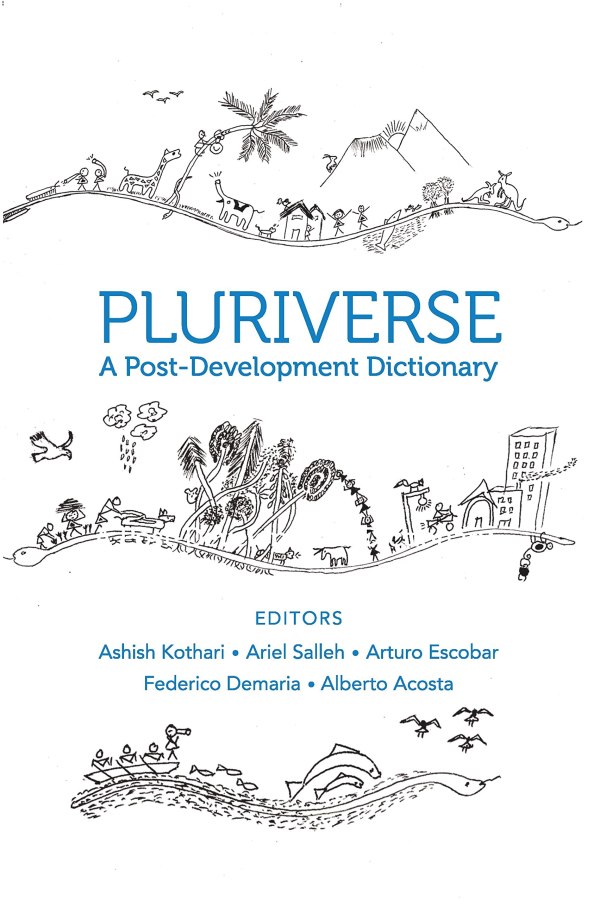
Pluriverse: A Post-Development Dictionary

Edited by Ashish Kothari, Ariel Salleh, Arturo Escobar, Federico Demaria, and Alberto Acosta

This book invites readers to join in a deep process of intellectual, emotional, ethical, and spiritual decolonization. The editors’ shared conviction is that the idea of ‘development as progress’ needs to be deconstructed to open a way for cultural alternatives that nurture and respect life on Earth. The dominant Western development model is a homogenizing construct, one that has usually been adopted by people across the world under material duress. The counter-term ‘post-development’ implies a myriad of systemic critiques and ways of living. This Dictionary is intended to re-politicize the ongoing debate over socio-ecological transformation by emphasizing its multi-dimensionality. It can be used for teaching and research; to inspire movement activists; to initiate the curious, and even those in power who no longer feel at ease with their world.

The editors are conscious of thematic and geographical gaps, but offer the book as an invitation to explore what they see as relational ‘ways of being’. This means remaking politics in a way that is deeply felt. Just so, in editing this book – as in any act of care – they themselves have encountered the limits of their own cultural reflexivity, even vulnerabilities, and in turn, discovered new understandings and acceptance. The ‘personal is political’, as feminists say. The book speaks to a worldwide confluence of economic, socio-political, cultural, and ecological visions. Each essay is written by someone who is deeply engaged with the world-view or practice described – from indigenous resisters to middle-class rebels.

The Dictionary is unconventional for its genre in having three parts. These reflect the historical transition that twenty-first century scholars and activists must work in: Development and Its Crises, Universalizing the Earth, and A People’s Pluriverse. The visions and practices contained in this Dictionary are not about applying a set of policies, instruments and indicators to exit ‘maldevelopment’. Rather, they are about recognizing the diversity of people’s views on planetary well-being and their skills in protecting it. They seek to ground human activities in the rhythms and frames of nature, respecting the interconnected materiality of all that lives. This indispensible knowledge needs to be held safe in the commons, not privatized or commodified for sale. The visions and practices offered here put buen vivir before material accumulation. They honour cooperation rather than competitiveness as the norm. They see work in pleasurable livelihoods, not ‘deadlihoods’ to escape from on weekends or ecotouristic vacations. Again, too often in the name of ‘development’, human creativity is destroyed by dull, homogenizing education systems.

They assemble this Dictionary to help in the collective search for an ecologically wise and socially just world. They envisage the book as contributing to a journey towards a Global Tapestry of Alternatives, strengthening hope and inspiration by learning from each other; strategizing advocacy and action; and building collaborative initiatives. In doing so, they do not underestimate the epistemological, political, and emotional challenges of remaking our own histories.

Read the full book here.

In The Belly Of The River : Tribal Conflicts Over Development In The Narmada Valley

By Amita Baviskar

Why are adivasis fighting the Narmada dam and other development projects in India today? Are adivasis ‘ecologically noble savages’ living in harmony with nature? What is the tribal relationship with nature today? How do people, whose struggles are the subject of theories of liberation and social change, perceive their own situation? Do their present circumstances allow adivasis to formulate a critique of ‘development’?

In the Belly of the River addresses these questions through an account of the lives of Bhilala adivasis in the Narmada valley who are fighting against displacement by the Sardar Sarovar dam in western India. On the basis of intensive fieldwork and historical research, this study places the tribal community in the context of its experience of state domination. Combining aspects of adivasi kinship and religion with the political economy of resource use, the book highlights the contradictions inherent in tribal relationships with nature – contradictions that permeate adivasi consciousness as well as practices

Read the book here.

Ashish Kothari

Image: By A. Kothari, “A touching moment with a Bonnet macaque baby”, Athirapally Falls, Kerala, Nov 2023.

Ashish Kothari is, in his words, “an Indian environmentalist working on development”, passionate about the environment and wildlife. In 1978-79, he helped found Kalpavriksh, a non-profit organisation in India which deals with environmental and development issues. From that time onwards, he has been associated with peoples’ movements like Narmada Bachao Andolan and Beej Bachao Andolan. He also helps coordinate national and global networks like Vikalp Sangam and Global Tapestry of Alternatives, and has been a member of different international commissions on environmental protection.

Kothari is the author/co-author and co-editor of about 30 books, and writer/co-writer of about 600 articles, most of which are available on his blog. He worked on a plethora of topics, including biodiversity, energy and climate, education, COVID-19, and social justice – complementing them with a wide range of artworks.

Explore Kothari’s works on his blog here.

The Stigma Matrix – Gender, Globalisation and the Agency of Pakistan’s Frontline Women

By Fauzia Husain

As developing states adopt neoliberal policies, more and more working-class women find themselves pulled into the public sphere. They are pressed into wage work by a privatizing and unstable job market. Likewise, they are pulled into public roles by gender mainstreaming policies that developing states must sign on to in order to receive transnational aid. Their inclusion into the political economy is very beneficial for society, but is it also beneficial for women? In The Stigma Matrix Fauzia Husain draws on the experiences of policewomen, lady health workers, and airline attendants, all frontline workers who help the Pakistani state, and its global allies, address, surveil, and discipline veiled women citizens. These women, she finds, confront a stigma matrix: a complex of local and global, historic, and contemporary factors that work together to complicate women’s integration into public life. The experiences of the three groups Husain examines reveal that inclusion requires more than quotas or special seats. This book advances critical feminist and sociological frameworks on stigma and agency showing that both concepts are made up of multiple layers of meaning, and are entangled with elite projects of hegemony.

Read more here.

Pluriverse A Post-Development Dictionary

Edited by Ashish Kothari, Ariel Salleh, Arturo Escobar, Federico Demaria, and Alberto Acosta

Pluriverse: A Post-Development Dictionary contains over one hundred essays on transformative initiatives and alternatives to the currently dominant processes of globalized development, including its structural roots in modernity, capitalism, state domination, and masculinist values. It offers critical essays on mainstream solutions that ‘greenwash’ development and presents radically different worldviews and practices from around the world that point to an ecologically wise and socially just world.

Read more here.

Create a website or blog at WordPress.com

Up ↑