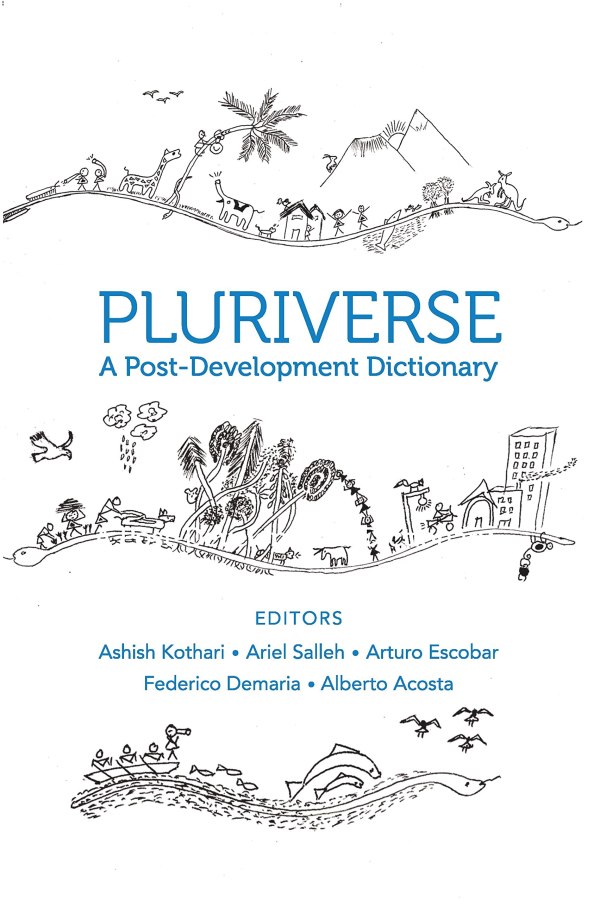
Pluriverse: A Post-Development Dictionary

Edited by Ashish Kothari, Ariel Salleh, Arturo Escobar, Federico Demaria, and Alberto Acosta

This book invites readers to join in a deep process of intellectual, emotional, ethical, and spiritual decolonization. The editors’ shared conviction is that the idea of ‘development as progress’ needs to be deconstructed to open a way for cultural alternatives that nurture and respect life on Earth. The dominant Western development model is a homogenizing construct, one that has usually been adopted by people across the world under material duress. The counter-term ‘post-development’ implies a myriad of systemic critiques and ways of living. This Dictionary is intended to re-politicize the ongoing debate over socio-ecological transformation by emphasizing its multi-dimensionality. It can be used for teaching and research; to inspire movement activists; to initiate the curious, and even those in power who no longer feel at ease with their world.

The editors are conscious of thematic and geographical gaps, but offer the book as an invitation to explore what they see as relational ‘ways of being’. This means remaking politics in a way that is deeply felt. Just so, in editing this book – as in any act of care – they themselves have encountered the limits of their own cultural reflexivity, even vulnerabilities, and in turn, discovered new understandings and acceptance. The ‘personal is political’, as feminists say. The book speaks to a worldwide confluence of economic, socio-political, cultural, and ecological visions. Each essay is written by someone who is deeply engaged with the world-view or practice described – from indigenous resisters to middle-class rebels.

The Dictionary is unconventional for its genre in having three parts. These reflect the historical transition that twenty-first century scholars and activists must work in: Development and Its Crises, Universalizing the Earth, and A People’s Pluriverse. The visions and practices contained in this Dictionary are not about applying a set of policies, instruments and indicators to exit ‘maldevelopment’. Rather, they are about recognizing the diversity of people’s views on planetary well-being and their skills in protecting it. They seek to ground human activities in the rhythms and frames of nature, respecting the interconnected materiality of all that lives. This indispensible knowledge needs to be held safe in the commons, not privatized or commodified for sale. The visions and practices offered here put buen vivir before material accumulation. They honour cooperation rather than competitiveness as the norm. They see work in pleasurable livelihoods, not ‘deadlihoods’ to escape from on weekends or ecotouristic vacations. Again, too often in the name of ‘development’, human creativity is destroyed by dull, homogenizing education systems.

They assemble this Dictionary to help in the collective search for an ecologically wise and socially just world. They envisage the book as contributing to a journey towards a Global Tapestry of Alternatives, strengthening hope and inspiration by learning from each other; strategizing advocacy and action; and building collaborative initiatives. In doing so, they do not underestimate the epistemological, political, and emotional challenges of remaking our own histories.

Read the full book here.

Cancer and the Kali Yuga: Gender, Inequality, and Health in South India

By Cecilia Coale Van Hollen

As news spread that more women died from breast and cervical cancer in India than anywhere else in the world in the early twenty-first century, global public health planners accelerated efforts to prevent, screen, and treat these reproductive cancers in low-income Indian communities. Cancer and the Kali Yuga reveals that women who are the targets of these interventions in Tamil Nadu, South India, hold views about cancer causality, late diagnosis, and challenges to accessing treatment that differ from the public health discourse. Cecilia Coale Van Hollen’s critical feminist ethnography centers and amplifies the voices of Dalit Tamil women who situate cancer within the nexus of their class, caste, and gender positions. Dalit women’s narratives about their experiences with cancer present a powerful and poignant critique of the sociocultural and political-economic conditions that marginalize them and jeopardize their health and well-being in twenty-first-century India.

Read the book here.

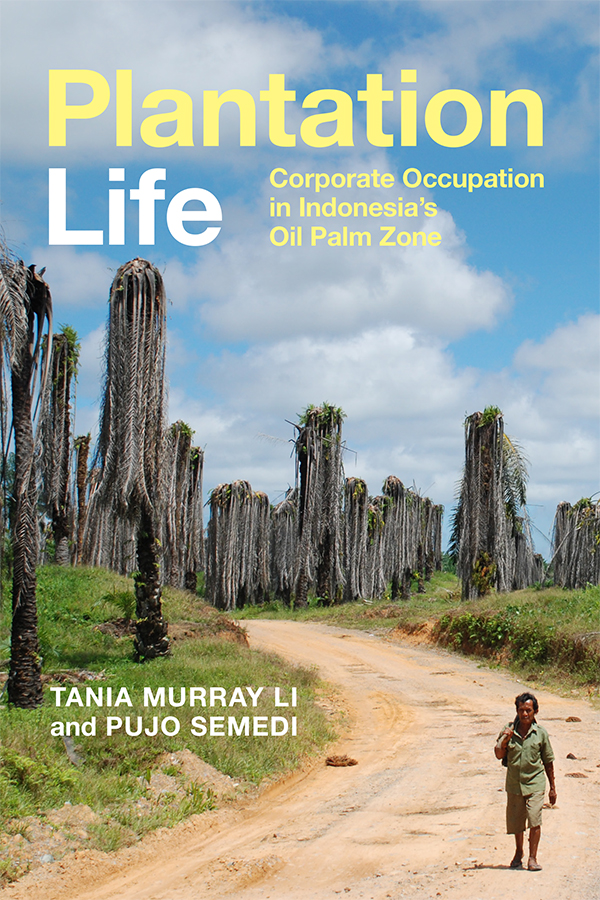
Plantation Life: Corporate Occupation in Indonesia’s Oil Palm Zone

By Tania Murray Li and Pujo Semedi

In Plantation Life, Tania Murray Li and Pujo Semedi examine the structure and governance of Indonesia’s contemporary oil palm plantations in Indonesia, which supply 50 percent of the world’s palm oil. They attend to the exploitative nature of plantation life, wherein villagers’ well-being is sacrificed in the name of economic development. While plantations are often plagued by ruined ecologies, injury among workers, and a devastating loss of livelihoods for former landholders, small-scale independent farmers produce palm oil more efficiently and with far less damage to life and land. Li and Semedi theorize “corporate occupation” to underscore how massive forms of capitalist production and control over the palm oil industry replicate colonial-style relations that undermine citizenship. In so doing, they question the assumption that corporations are necessary for rural development, contending that the dominance of plantations stems from a political system that privileges corporations.

Read the book here.

Virtually Virgins: Sexual Strategies and Cervical Cancer in Recife, Brazil

By Jessica L. Gregg

This book provides a detailed, intimate portrait of a community of women living in a shantytown (favela) in northeastern Brazil, while exploring the complex interplay between gender, sexuality, power, and disease. It reveals how poor Brasileiras are constrained by dominant cultural constructions of female sexuality as a dangerous force that must be controlled by men; yet these women also manipulate these expectations by using their sexuality as a means to secure economic support from men. The book argues that these constructions affect their interpretations of medical discourse on the prevention of cervical cancer. Since women view sex as both a force they can’t control and as a necessary tool for their survival, they choose to de-emphasize medical warnings against risky sexual behavior, with grave consequences for their health. The text is threaded with poignant, humorous, sometimes graphic, and always memorable depictions of the women’s lives in the shantytowns, making this serious anthropological study a highly readable one as well.

Read this book here.

Create a website or blog at WordPress.com

Up ↑