Cancer and the Kali Yuga: Gender, Inequality, and Health in South India

By Cecilia Coale Van Hollen

As news spread that more women died from breast and cervical cancer in India than anywhere else in the world in the early twenty-first century, global public health planners accelerated efforts to prevent, screen, and treat these reproductive cancers in low-income Indian communities. Cancer and the Kali Yuga reveals that women who are the targets of these interventions in Tamil Nadu, South India, hold views about cancer causality, late diagnosis, and challenges to accessing treatment that differ from the public health discourse. Cecilia Coale Van Hollen’s critical feminist ethnography centers and amplifies the voices of Dalit Tamil women who situate cancer within the nexus of their class, caste, and gender positions. Dalit women’s narratives about their experiences with cancer present a powerful and poignant critique of the sociocultural and political-economic conditions that marginalize them and jeopardize their health and well-being in twenty-first-century India.

Read the book here.
Pills That Swallow Policy: Clinical Ethnography of a Community Mental Health Program in Northern India

By Sumeet Jain and Sushrut Jadhav

India’s National Mental Health Program (NMHP) was initiated in 1982 with the objective of promoting community participation and accessible mental health services. A key component involves central government calculation and funding for psychotropic medication. Based on clinical ethnography of a community psychiatry program in north India, this article traces the biosocial journey of psychotropic pills from the centre to the periphery. As the pill journeys from the Ministry of Health to the clinic, its symbolic meaning transforms from an emphasis on accessibility and participation to the administration of a discrete ‘treatment’. Instead of embodying participation and access, the pill achieves the opposite: silencing community voices, re-enforcing existing barriers to care, and relying on pharmacological solutions for psychosocial problems. The symbolic inscription of NMHP policies on the pill fail because they are undercut by more powerful meanings generated from local cultural contexts. An understanding of this process is critical for the development of training and policy that can more effectively address local mental health concerns in rural India.

Read the article here.

No Aging In India: Alzheimer’s, The Bad Family, and Other Modern Things.

By Lawrence Cohen

From the opening sequence, in which mid-nineteenth-century Indian fishermen hear the possibility of redemption in an old woman’s madness, No Aging in India captures the reader with its interplay of story and analysis. Drawing on more than a decade of ethnographic work, Lawrence Cohen links a detailed investigation of mind and body in old age in four neighborhoods of the Indian city of Varanasi (Banaras) with events and processes around India and around the world. This compelling exploration of senility—encompassing not only the aging body but also larger cultural anxieties—combines insights from medical anthropology, psychoanalysis, and postcolonial studies. Bridging literary genres as well as geographic spaces, Cohen responds to what he sees as the impoverishment of both North American and Indian gerontologies—the one mired in ambivalence toward demented old bodies, the other insistent on a dubious morality tale of modern families breaking up and abandoning their elderly. He shifts our attention irresistibly toward how old age comes to matter in the constitution of societies and their narratives of identity and history.

Read the book here.

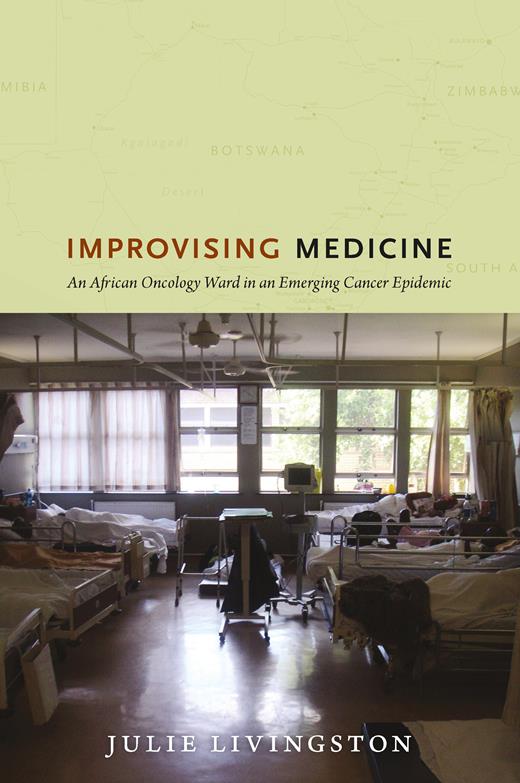
Improvising Medicine: An African Oncology Ward in an Emerging Cancer Epidemic

By Julie Livingston

In Improvising Medicine, Livingston tells the story of Botswana’s only dedicated cancer ward, located in its capital city of Gaborone. This affecting ethnography follows patients, their relatives, and ward staff as a cancer epidemic emerged in Botswana. The epidemic is part of an ongoing surge in cancers across the Global South; the stories of Botswana’s oncology ward dramatize the human stakes and intellectual and institutional challenges of an epidemic that will shape the future of global health. They convey the contingencies of high-tech medicine in a hospital where vital machines are often broken, drugs go in and out of stock, and bed-space is always at a premium. They also reveal cancer as something that happens between people. Serious illness, care, pain, disfigurement, and even death emerge as deeply social experiences. Livingston describes the cancer ward in terms of the bureaucracy, vulnerability, power, biomedical science, mortality, and hope that shape contemporary experience in southern Africa. Her ethnography is a profound reflection on the social orchestration of hope and futility in an African hospital, the politics and economics of healthcare in Africa, and palliation and disfigurement across the Global South.

Read the book here.

Living with Oil and Coal: Resource Politics and Militarization in Northeast India

By Dolly Kikon

Photo: Dexter Fernandes

The nineteenth-century discovery of oil in the eastern Himalayan foothills, together with the establishment of tea plantations and other extractive industries, continues to have a profound impact on life in the region. In the Indian states of Assam and Nagaland, everyday militarization, violence, and the scramble for natural resources regulate the lives of Naga, Ahom, and Adivasi people, as well as migrants from elsewhere in the region, as they struggle to find peace and work.

Anthropologist Dolly Kikon uses in-depth ethnographic accounts to address the complexity of Northeast India, a region where boundaries and borders are made, disputed, and maintained. She mainly explores the social bonds established through practices of resource extraction and the tensions these relations generate, focusing on peoples’ love for the landscape and for the state, as well as for family, friends, and neighbors. Living with Oil and Coal illuminates questions of citizenship, social justice, and environmental politics that are shared by communities worldwide.

Read the book here.

Marked Women: The Cultural Politics of Cervical Cancer in Venezuela

By Rebecca G. Martinez

Cervical cancer is the third leading cause of death among women in Venezuela, with poor and working-class women bearing the brunt of it. Doctors and public health officials regard promiscuity and poor hygiene—coded indicators for low class, low culture, and bad morals—as risk factors for the disease.

Drawing on in-depth fieldwork conducted in two oncology hospitals in Caracas, Marked Women is an ethnography of women’s experiences with cervical cancer, the doctors and nurses who treat them, and the public health officials and administrators who set up intervention programs to combat the disease. Rebecca G. Martínez contextualizes patient-doctor interactions within a historical arc of Venezuelan nationalism, modernity, neoliberalism, and Chavismo to understand the scientific, social, and political discourses surrounding the disease. The women, marked as deviant for their sexual transgressions, are not only characterized as engaging in unhygienic, uncultured, and promiscuous behaviors, but also become embodiments of these very behaviors. Ultimately, Marked Women explores how epidemiological risk is a socially, culturally, and historically embedded process—and how this enables cervical cancer to stigmatize women as socially marginal, burdens on society, and threats to the “health” of the modern nation.

Read more here.

Create a website or blog at WordPress.com

Up ↑