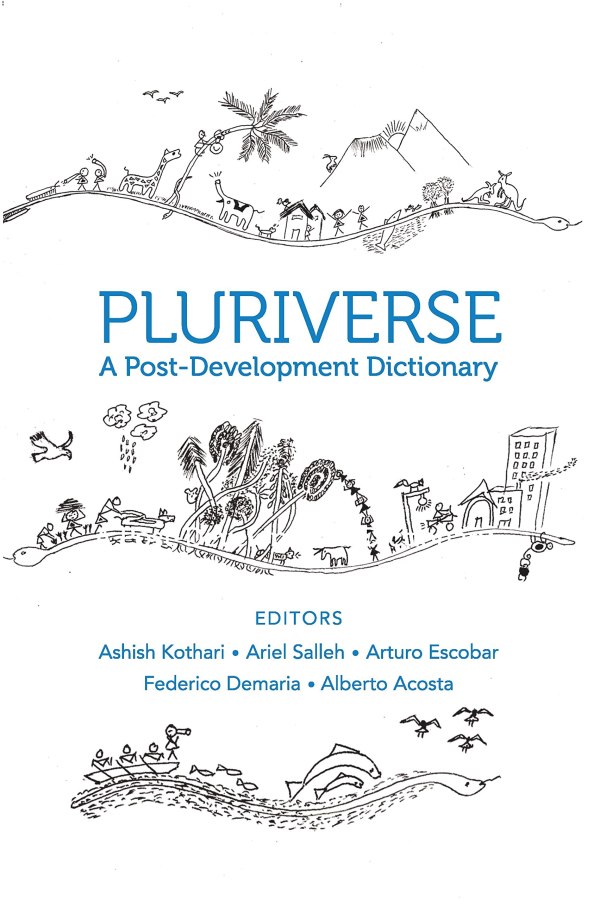
Pluriverse: A Post-Development Dictionary

Edited by Ashish Kothari, Ariel Salleh, Arturo Escobar, Federico Demaria, and Alberto Acosta

This book invites readers to join in a deep process of intellectual, emotional, ethical, and spiritual decolonization. The editors’ shared conviction is that the idea of ‘development as progress’ needs to be deconstructed to open a way for cultural alternatives that nurture and respect life on Earth. The dominant Western development model is a homogenizing construct, one that has usually been adopted by people across the world under material duress. The counter-term ‘post-development’ implies a myriad of systemic critiques and ways of living. This Dictionary is intended to re-politicize the ongoing debate over socio-ecological transformation by emphasizing its multi-dimensionality. It can be used for teaching and research; to inspire movement activists; to initiate the curious, and even those in power who no longer feel at ease with their world.

The editors are conscious of thematic and geographical gaps, but offer the book as an invitation to explore what they see as relational ‘ways of being’. This means remaking politics in a way that is deeply felt. Just so, in editing this book – as in any act of care – they themselves have encountered the limits of their own cultural reflexivity, even vulnerabilities, and in turn, discovered new understandings and acceptance. The ‘personal is political’, as feminists say. The book speaks to a worldwide confluence of economic, socio-political, cultural, and ecological visions. Each essay is written by someone who is deeply engaged with the world-view or practice described – from indigenous resisters to middle-class rebels.

The Dictionary is unconventional for its genre in having three parts. These reflect the historical transition that twenty-first century scholars and activists must work in: Development and Its Crises, Universalizing the Earth, and A People’s Pluriverse. The visions and practices contained in this Dictionary are not about applying a set of policies, instruments and indicators to exit ‘maldevelopment’. Rather, they are about recognizing the diversity of people’s views on planetary well-being and their skills in protecting it. They seek to ground human activities in the rhythms and frames of nature, respecting the interconnected materiality of all that lives. This indispensible knowledge needs to be held safe in the commons, not privatized or commodified for sale. The visions and practices offered here put buen vivir before material accumulation. They honour cooperation rather than competitiveness as the norm. They see work in pleasurable livelihoods, not ‘deadlihoods’ to escape from on weekends or ecotouristic vacations. Again, too often in the name of ‘development’, human creativity is destroyed by dull, homogenizing education systems.

They assemble this Dictionary to help in the collective search for an ecologically wise and socially just world. They envisage the book as contributing to a journey towards a Global Tapestry of Alternatives, strengthening hope and inspiration by learning from each other; strategizing advocacy and action; and building collaborative initiatives. In doing so, they do not underestimate the epistemological, political, and emotional challenges of remaking our own histories.

Read the full book here.

Osiris (Vol. 39): Disability and the History of Science

Edited by Jaipreet Virdi, Mara Mills, and Sara F. Rose

Disability has been a central—if unacknowledged—force in the history of science, as in the scientific disciplines. Across historical epistemology and laboratory research, disability has been “good to think with”: an object of investigation made to yield generalizable truths. Yet disability is rarely imagined to be the source of expertise, especially the kind of expertise that produces (rational, neutral, universal) scientific knowledge.

This volume of Osiris places disability history and the history of science in conversation to foreground disability epistemologies, disabled scientists, and disability sciencing (engagement with scientific tools and processes). Looking beyond paradigms of medicalization and industrialization, the volume authors also examine knowledge production about disability from the ancient world to the present in fields ranging from mathematics to the social sciences, resulting in groundbreaking histories of taken-for-granted terms such as impairment, infirmity, epidemics, and shōgai.

Some contributors trace the disabling impacts of scientific theories and practices in the contexts of war, factory labor, insurance, and colonialism; others excavate racial and settler ableism in the history of scientific facts, protocols, and collections; still others query the boundaries between scientific, lay, and disability expertise. Contending that disability alters method, authors bring new sources and interpretation techniques to the history of science, overturn familiar narratives, apply disability analyses to established terms and archives, and discuss accessibility issues for disabled historians. The resulting volume announces a disability history of science.

Read the book here.

A History of Indigenous Australia and the University of Melbourne

By Dhoombak Goobgoowana

Dhoombak Goobgoowana can be translated as ‘truth telling’ in the Woi Wurrung language of the Wurundjeri Woi Wurrung people on whose unceded lands several University of Melbourne campuses are located.

Volume 1: Truth

This book, the first of two volumes, is an attempt to acknowledge and publicly address the long, complex and troubled relationship between the Indigenous people of what we now call the continent of Australia and the University of Melbourne.

It is a book about race and how it has been constructed by academics in the University. It is also about power and how academics have wielded it and justified its use against Indigenous populations, and about knowledge, especially the Indigenous knowledge that silently contributed to many early research projects and collection endeavours.

Although many things have changed, the stain of the past remains. But the University no longer wishes to look away.

Read Volume 1 of the book here.

Volume 2: Voice

Volume 2 reveals the pivotal role played by Indigenous people in the history of the University of Melbourne.

It traces the University’s role in ignoring and quietening Indigenous peoples’ voices, and the reverberations created by those voices that broke through. It shows how collections of art and cultural objects have transitioned from texts for western interpretation to expressions of self-identity. It reveals the Indigenous pioneers who gained admission to the University as students more than a century after it was established, and then later as staff, and documents their triumphs and struggles.

This second volume, following the revelations of Dhoombak Goobgoowana Volume I: Truth, shows how Indigenous communities challenged and disrupted the University, how they contributed to its research endeavours and exhorted it to introduce Indigenous knowledge into the academic sphere.

Imperfect, overdue and then often painfully slow, but marked by stories of courage and hope—this is what a history of inclusion looks like.

Read Volume 2 of the book here.

Aboriginal and Torres Strait Islander readers are advised that Dhoombak Goobgoowana contains images and names of people who have died. Readers are also advised that they may be disturbed by the content of this book, which includes distressing images and descriptions, and derogatory terms for Indigenous people used in their historical context.

Because its power remains naturalized: introducing the settler colonial determinants of health

By Bram Wispelwey, Osama Tanous, Yara Asi, Weeam Hammoudeh, and David Mills

Indigenous people suffer earlier death and more frequent and severe disease than their settler counterparts, a remarkably persistent reality over time, across settler colonized geographies, and despite their ongoing resistance to elimination. Although these health inequities are well-known, they have been impervious to comprehensive and convincing explication, let alone remediation. Settler colonial studies, a fast-growing multidisciplinary and interdisciplinary field, is a promising candidate to rectify this impasse. Settler colonialism’s relationship to health inequity is at once obvious and incompletely described, a paradox arising from epistemic coloniality and perceived analytic challenges that we address here in three parts. First, in considering settler colonialism an enduring structure rather than a past event, and by wedding this fundamental insight to the ascendant structural paradigm for understanding health inequities, a picture emerges in which this system of power serves as a foundational and ongoing configuration determining social and political mechanisms that impose on human health. Second, because modern racialization has served to solidify and maintain the hierarchies of colonial relations, settler colonialism adds explanatory power to racism’s health impacts and potential amelioration by historicizing this process for differentially racialized groups. Finally, advances in structural racism methodologies and the work of a few visionary scholars have already begun to elucidate the possibilities for a body of literature linking settler colonialism and health, illuminating future research opportunities and pathways toward the decolonization required for health equity.

Read the article here.

In The Belly Of The River : Tribal Conflicts Over Development In The Narmada Valley

By Amita Baviskar

Why are adivasis fighting the Narmada dam and other development projects in India today? Are adivasis ‘ecologically noble savages’ living in harmony with nature? What is the tribal relationship with nature today? How do people, whose struggles are the subject of theories of liberation and social change, perceive their own situation? Do their present circumstances allow adivasis to formulate a critique of ‘development’?

In the Belly of the River addresses these questions through an account of the lives of Bhilala adivasis in the Narmada valley who are fighting against displacement by the Sardar Sarovar dam in western India. On the basis of intensive fieldwork and historical research, this study places the tribal community in the context of its experience of state domination. Combining aspects of adivasi kinship and religion with the political economy of resource use, the book highlights the contradictions inherent in tribal relationships with nature – contradictions that permeate adivasi consciousness as well as practices

Read the book here.

The need for historical fluency in public health law and ethics

By Daniel S. Goldberg

In this seminar, Daniel S. Goldberg discusses the importance of understanding historical patterns of domination, oppression, and subordination to tackle health and social justice; the role of law as a social determinant of health; and the significance of historical fluency in public health law and ethics.  

The primary claim of this talk is that historical fluency is critical to effective scholarship and advocacy in public health law & ethics. In explaining such fluency and supporting this claim, several foundational ideas are relevant. First, law is a powerful social determinant of health. Historical analysis of population health problems connected to communicable disease, non-communicable disease, and injury helps demonstrate the deep connections between laws and health outcomes. Second, as to ethics, Powers & Faden’s health sufficiency model of social justice suggests that factors intensifying “densely-woven patterns of disadvantage” are of highest priority. Such factors are most responsible for expanding health inequities and they overwhelmingly track historical patterns of domination, oppression, and subordination. Taken together, these foundational ideas in public health law and public health ethics show why historical fluency is critical to advancing health and social justice. The final portion of the presentation will apply the analysis to a particular case study (the 1900 outbreak of bubonic plague in San Francisco, CA) to illustrate the significance of historical fluency in public health law & ethics. 

Read more and watch the seminar here.

Create a website or blog at WordPress.com

Up ↑