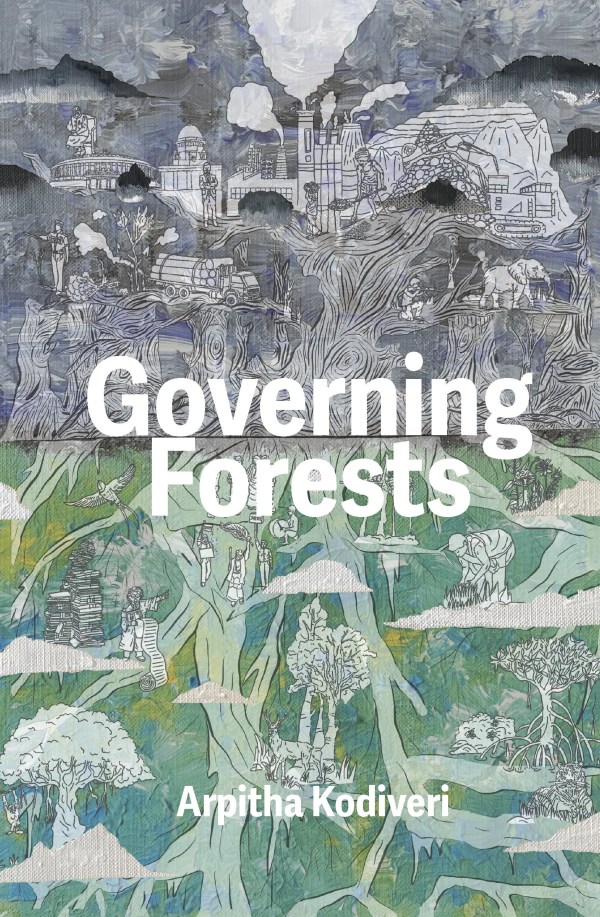
Governing Forests: State, Law and Citizenship in India’s Forests

By Arpitha Kodiveri

The nations of the Global North are responding to the climate change emergency with emissions trading schemes and alternative sources of energy. Meanwhile, nations of the Global South, still emerging from historical exploitation under colonialism, face decisions about natural resource use that are, for traditional owners and inhabitants of resource – rich lands, often a matter of life or death.

This book is the culmination of seven years immersed in the legal struggles of diverse forest-dwelling communities in India. Inspired by these social movements, Kodiveri tell the stories of how adivasi communities are using and shaping the law through clever legal interpretation and activism. The law Kodiveri shows is expanded, reframed and rendered malleable by forest-dwelling indigenous communities to be inclusive of their visions of justice, all while other laws seek to criminalize and erase their rights to land and waters.

Read the book here.

A History of Indigenous Australia and the University of Melbourne

By Dhoombak Goobgoowana

Dhoombak Goobgoowana can be translated as ‘truth telling’ in the Woi Wurrung language of the Wurundjeri Woi Wurrung people on whose unceded lands several University of Melbourne campuses are located.

Volume 1: Truth

This book, the first of two volumes, is an attempt to acknowledge and publicly address the long, complex and troubled relationship between the Indigenous people of what we now call the continent of Australia and the University of Melbourne.

It is a book about race and how it has been constructed by academics in the University. It is also about power and how academics have wielded it and justified its use against Indigenous populations, and about knowledge, especially the Indigenous knowledge that silently contributed to many early research projects and collection endeavours.

Although many things have changed, the stain of the past remains. But the University no longer wishes to look away.

Read Volume 1 of the book here.

Volume 2: Voice

Volume 2 reveals the pivotal role played by Indigenous people in the history of the University of Melbourne.

It traces the University’s role in ignoring and quietening Indigenous peoples’ voices, and the reverberations created by those voices that broke through. It shows how collections of art and cultural objects have transitioned from texts for western interpretation to expressions of self-identity. It reveals the Indigenous pioneers who gained admission to the University as students more than a century after it was established, and then later as staff, and documents their triumphs and struggles.

This second volume, following the revelations of Dhoombak Goobgoowana Volume I: Truth, shows how Indigenous communities challenged and disrupted the University, how they contributed to its research endeavours and exhorted it to introduce Indigenous knowledge into the academic sphere.

Imperfect, overdue and then often painfully slow, but marked by stories of courage and hope—this is what a history of inclusion looks like.

Read Volume 2 of the book here.

Aboriginal and Torres Strait Islander readers are advised that Dhoombak Goobgoowana contains images and names of people who have died. Readers are also advised that they may be disturbed by the content of this book, which includes distressing images and descriptions, and derogatory terms for Indigenous people used in their historical context.
Because its power remains naturalized: introducing the settler colonial determinants of health

By Bram Wispelwey, Osama Tanous, Yara Asi, Weeam Hammoudeh, and David Mills

Indigenous people suffer earlier death and more frequent and severe disease than their settler counterparts, a remarkably persistent reality over time, across settler colonized geographies, and despite their ongoing resistance to elimination. Although these health inequities are well-known, they have been impervious to comprehensive and convincing explication, let alone remediation. Settler colonial studies, a fast-growing multidisciplinary and interdisciplinary field, is a promising candidate to rectify this impasse. Settler colonialism’s relationship to health inequity is at once obvious and incompletely described, a paradox arising from epistemic coloniality and perceived analytic challenges that we address here in three parts. First, in considering settler colonialism an enduring structure rather than a past event, and by wedding this fundamental insight to the ascendant structural paradigm for understanding health inequities, a picture emerges in which this system of power serves as a foundational and ongoing configuration determining social and political mechanisms that impose on human health. Second, because modern racialization has served to solidify and maintain the hierarchies of colonial relations, settler colonialism adds explanatory power to racism’s health impacts and potential amelioration by historicizing this process for differentially racialized groups. Finally, advances in structural racism methodologies and the work of a few visionary scholars have already begun to elucidate the possibilities for a body of literature linking settler colonialism and health, illuminating future research opportunities and pathways toward the decolonization required for health equity.

Read the article here.

Why Indigenous People Want You to Stop Labeling Them as Latino

By Odilia Romero

In this fascinating and necessary Talk, Odilia Romero shares why the Latino narrative is oppressive for Indigenous communities. Through her nonprofit CIELO, listen to how Odilia fights for language rights and provides interpretation services to Indigenous communities across the United States.


As a fierce Zapotec leader, Odilia Romero is the co-founder of Comunidades Indigenas en Liderazgo (CIELO), advocating for Indigenous migrant rights in Los Angeles & throughout California. She is also an independent interpreter of Zapotec, Spanish, and English for Indigenous communities & her organizing knowledge & experience are held in high regard, with multiple academic publications, awards, & lectures in universities across the United States, including John Hopkins, USC, and UCLA. Ms. Romero’s work has also been featured in the Los Angeles Times, the New York Times, Vogue and Democracy Now. This talk was given at a TEDx event using the TED conference format but independently organized by a local community.

Coloniality of Power and Coloniality of Gender: Sentipensar the Struggles of Indigenous Women in Abya Yala from Worlds in Relation

By Carmen Cariño and Alejandro Montelongo González

Read more here.

Tequiologies: Indigenous Solutions Against Climate Catastrophe

Berkeley Center for New Media: History and Theory of New Media Lecture Series

with Yásnaya Elena Aguilar Gil
Linguist, writer, translator, language rights activist, and researcher ayuujk (mixe)
Introduced and moderated by Natalia Brizuela and Alex Saum-Pascual
Presented in partnership with the Center for Latin American Studies. Co-sponsored by Alianza UCMX, Spanish & Portuguese, the Arts Research Center, and The American Indian Graduate Program.

It is a myth of the West’s choosing: perpetual economic growth, advancing through a digestive system of sorts, one that uses technology as one of its core components. In its churn, ecosystems became goods; people, mere consumers. The myth turned the world into a place increasingly inhospitable to human life. An alternative, offered by Abya Yala, lies in separating economic development and the development of new technologies from consumerism. This would place technological creation and ingenuity once again at the service of the common good, not of the market. Technology as tequio; technological creation and innovation as a common good.

Read more here.

Handbook of Critical and Indigenous Methodologies

Edited by Norman K. Denzin, Yvonna S. Lincoln and Linda Tuhiwai Smith

    The Handbook of Critical Methodologies covers everything from the history of critical and indigenous theory and how it came to inform and impact qualitative research and indigenous peoples to the critical constructs themselves, including race/diversity, gender representation (queer theory, feminism), culture, and politics to the meaning of “critical” concepts within specific disciplines (critical psychology, critical communication/mass communication, media studies, cultural studies, political economy, education, sociology, anthropology, history, etc. – all in an effort to define emancipatory research and explore what critical qualitative research can do for social change and social justice.

    Read more here.

    Layered spaces: a pedagogy of uncomfortable reflexivity in Indigenous education

    By Ailie McDowall

    University disciplines are grappling with how best to incorporate Indigenous content and frameworks for practice into their teaching to better prepare graduates to work with Indigenous communities. Yet the pedagogical approaches that can best engage students in Indigenous Studies as a field of critical study are still being debated.

    This article has two aims. The first is to consider how an uncomfortable reflexivity may provide an alternative theoretical and methodological approach to preparing university students for future work. The second aim is to consider Nakata’s cultural interface as a teaching tool that may open discussion around how professionals embody the disciplinary histories that govern their work.

    Read more here.

    Create a website or blog at WordPress.com

    Up ↑