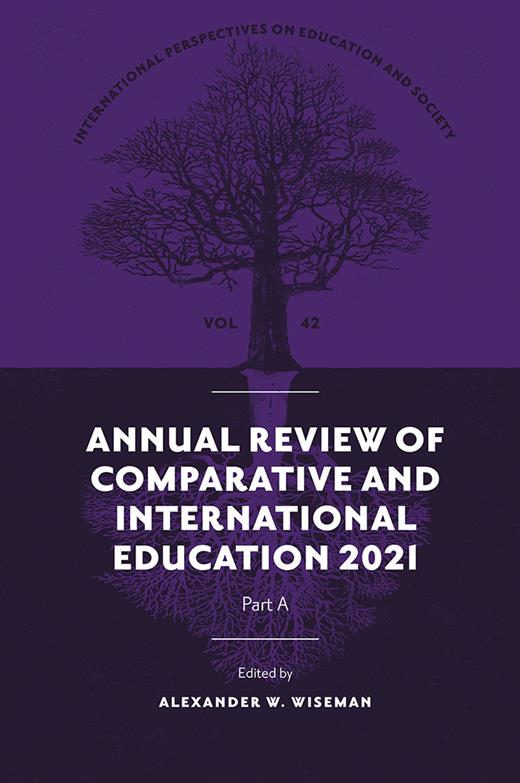
Decolonization of Education Research, Policy-making, and Practice in Central Asia: The Case of Tajikistan

By Sarfaroz Niyozov and Stephen A. Bahry

This chapter in Annual Review of Comparative and International Education 2021 reviews the challenges facing educational research and knowledge production, in the independent post-Soviet Central Asia through examination of the case of Tajikistan.

The chapter revisits issues discussed in Niyozov and Bahry (2006) on the need for research-based approaches to with these challenges, taking up Tlostanova’s (2015) challenge to see Central Asian educational history as repeated intellectual colonization, decolonization, and recolonization leading her to question whether Central Asians can think, or must simply accept policies and practices that travel from elsewhere. The authors respond by reviewing Tajikistan as representative in many aspects, if not all particulars, of the entire region. Part one of the review describes data sources, analyses, and our positionalities. Part two reviews decolonization in comparative, international, and development education and in post-Soviet education. Part three describes education research and knowledge production types and their key features. Thereafter, the authors discuss additional challenges facing Tajikistan’s and the region’s knowledge production and link them to the possibilities of decolonization discourse.

The authors conclude by suggesting realistic steps the country’s scholars and their comparative international education colleagues may take to move toward developing both research capacity and decolonization of knowledge pursuits in Tajikistan and Central Asia.

Read this chapter here.

The foreign gaze: authorship in academic global health

By Seye Abimbola

“There is a problem of gaze at the heart of academic global health. It is difficult to name. […] Recent bibliometric analyses confirm autorship imbalances patterns that are largely explained by entrenched power asymmetries in global health partnerships — between researchers in high-income countries (often the source of funds and agenda) and those in middle-income and especially low-income countries (where the research is often conducted). But we cannot talk about authorship without grappling with who we are as authors, who we imagine we write for (i.e., gaze), and the position or standpoint from which we write (i.e., pose).”

Drawing on the ideas of ‘foreign’ and ‘local’ gaze, Abimbola highlights how imbalances in autorship are generally a reflection of wider power inequalities in the production and dissemination of knowledge in global health.

Read the article here.

Between a Rock and a Hard Place: Ethics of Fieldwork in Northwest Pakistan

By Ping-hsiu Alice Lin

Photo: Ihtasham Ali

In the wake of the US-led and Pakistan-allied “war on terror”, residents in Northwest Pakistan have faced inconceivable structural and physical violence, in ways that pose ethical challenges in ethnographic writing and research. Over the last few decades, militancy, banditry and overall insecurity have hampered relief efforts in the area and significantly weakened basic infrastructure. In this article, the author illustrates how an initial security plan to undertake fieldwork research in this “volatile” region proved somewhat irrelevant because of her positionality, gender and race/ethnicity. The author explores the implications of these dynamics in contexts characterized by unequal gender relations and strict gender segregation. In addition, undertaking empirical work in the context of epistemological frameworks in a region that has been subjected to active conflict, militarised operations and a singular representation in the global and local media, poses other ethical challenges for anthropologists searching for new areas of study and decolonised models of representation. This paper reiterates the importance of a reflexive approach of ethics that acknowledges the interpenetration of race, gender and the thick web of relationships in the production of knowledge and is, at the same time, respectful of cultural specificity.

Read more here.

Decolonial subversions

Decolonial subversions is a radically, innovative, multilingual, open-access, peer-reviewed platform for the expression of historically silenced knowledge systems. It is commited to decentring western epistemology in the humanities and social sciences.

The platform seeks to minimise the reproduction of publishing practices that perpetuate inequalities in the global production and distribution of knowledge. It is a platform for the creation and dissemination of written, acoustic and visual knowledge from the margins.

As another way of decentring western epistemology and diversifying knowledge-making, authors are encouraged to submit their contributions in local languages, where an English version can also be provided, or to translate contributions in English into local languages as pertinent to the communities of research.

Journey into their 2023 Special Issue here.

Create a website or blog at WordPress.com

Up ↑