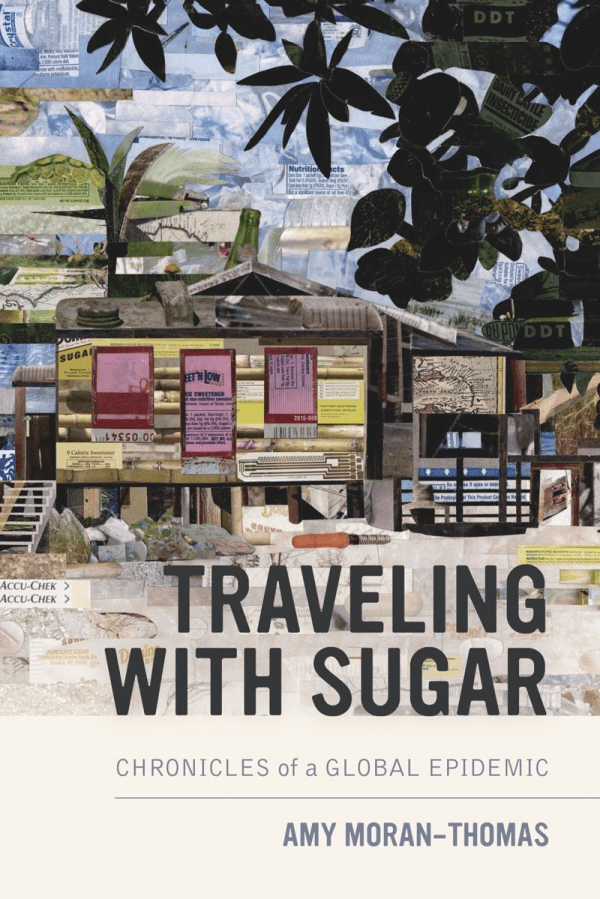
Traveling with Sugar: Chronicles of a Global Epidemic

By Amy Moran-Thomas

Traveling with Sugar reframes the rising diabetes epidemic as part of a five-hundred-year-old global history of sweetness and power. Amid eerie injuries, changing bodies, amputated limbs, and untimely deaths, many people across the Caribbean and Central America simply call the affliction “sugar” -or, as some say in Belize, “traveling with sugar.” A decade in the making, this book unfolds as a series of crónicas -a word meaning both slow-moving story and slow-moving disease. It profiles the careful work of those “still fighting it” as they grapple with unequal material infrastructures and unsettling dilemmas. Facing a new incarnation of blood sugar, these individuals speak back to science and policy misrecognitions that have prematurely cast their lost limbs and deaths as normal. Their families’ arts of maintenance and repair illuminate ongoing struggles to survive and remake larger systems of food, land, technology, and medicine.

Read the book here.

All That Was Not Her

By Todd Meyers

While studying caregiving and chronic illness in families living in situations of economic and social insecurity in Baltimore, anthropologist Todd Meyers met a woman named Beverly. In All That Was Not Her Meyers presents an intimate ethnographic portrait of Beverly, stitching together small moments they shared scattered over months and years and, following her death, into the present. He meditates on the possibilities of writing about someone who is gone – what should be represented, what experiences resist rendering, what ethical challenges exist when studying the lives of others. Meyers considers how chronic illness is bound up in the racialized and socioeconomic conditions of Beverly’s life and explores the stakes of the anthropologist’s engagement with one subject. Even as Meyers struggles to give Beverly the final word, he finds himself unmade alongside her. All That Was Not Her captures the complexity of personal relationships in the field and the difficulty of their ending.

Read the book here.

Chemonotes

By Harry M. Marks

Professor Harry M. Marks, faculty member in the Department of History of Medicine at Johns Hopkins University since 1989, died on 25 January 2011, aged 64. He served on the editorial board of Social History of Medicine and was a generous and exacting reviewer for the journal. As a memorial to Pr. Marks, some of his extraordinary personal reflections during his time as an outpatient undergoing treatment for prostate cancer were collated. He periodically emailed these musings to family members, friends and colleagues. At a memorial celebration held in Baltimore in February 2011, Gert Brieger observed that Harry Marks lived his life as if in a ‘perpetual teaching moment’. These emails stand in testament not only to that, but also to Marks’ rapacious intellectual curiosity, rasping critique, sense of humour, and, not least, remarkable fortitude.

Read his reflections here.

Critical Medical Anthropology: Perspectives in and from Latin America

Edited By Jennie Gamlin, Sahra Gibbon, Paola M. Sesia and Lina Berrio

Critical Medical Anthropology presents inspiring work from scholars doing and engaging with ethnographic research in or from Latin America, addressing themes that are central to contemporary Critical Medical Anthropology (CMA). This includes issues of inequality, embodiment of history, indigeneity, non-communicable diseases, gendered violence, migration, substance abuse, reproductive politics and judicialisation, as these relate to health. The collection of ethnographically informed research, including original theoretical contributions, reconsiders the broader relevance of CMA perspectives for addressing current global healthcare challenges from and of Latin America. It includes work spanning four countries in Latin America (Mexico, Brazil, Guatemala and Peru) as well as the trans-migratory contexts they connect and are defined by. By drawing on diverse social practices, it addresses challenges of central relevance to medical anthropology and global health, including reproduction and maternal health, sex work, rare and chronic diseases, the pharmaceutical industry and questions of agency, political economy, identity, ethnicity, and human rights.

Read more here.

Create a website or blog at WordPress.com

Up ↑