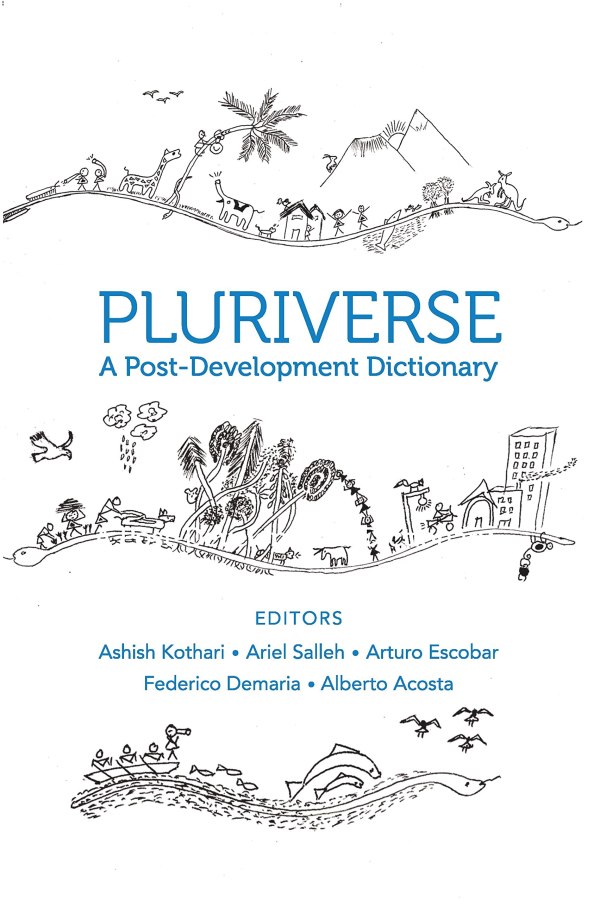
Edited by Ashish Kothari, Ariel Salleh, Arturo Escobar, Federico Demaria, and Alberto Acosta
This book invites readers to join in a deep process of intellectual, emotional, ethical, and spiritual decolonization. The editors’ shared conviction is that the idea of ‘development as progress’ needs to be deconstructed to open a way for cultural alternatives that nurture and respect life on Earth. The dominant Western development model is a homogenizing construct, one that has usually been adopted by people across the world under material duress. The counter-term ‘post-development’ implies a myriad of systemic critiques and ways of living. This Dictionary is intended to re-politicize the ongoing debate over socio-ecological transformation by emphasizing its multi-dimensionality. It can be used for teaching and research; to inspire movement activists; to initiate the curious, and even those in power who no longer feel at ease with their world.
The editors are conscious of thematic and geographical gaps, but offer the book as an invitation to explore what they see as relational ‘ways of being’. This means remaking politics in a way that is deeply felt. Just so, in editing this book – as in any act of care – they themselves have encountered the limits of their own cultural reflexivity, even vulnerabilities, and in turn, discovered new understandings and acceptance. The ‘personal is political’, as feminists say. The book speaks to a worldwide confluence of economic, socio-political, cultural, and ecological visions. Each essay is written by someone who is deeply engaged with the world-view or practice described – from indigenous resisters to middle-class rebels.
The Dictionary is unconventional for its genre in having three parts. These reflect the historical transition that twenty-first century scholars and activists must work in: Development and Its Crises, Universalizing the Earth, and A People’s Pluriverse. The visions and practices contained in this Dictionary are not about applying a set of policies, instruments and indicators to exit ‘maldevelopment’. Rather, they are about recognizing the diversity of people’s views on planetary well-being and their skills in protecting it. They seek to ground human activities in the rhythms and frames of nature, respecting the interconnected materiality of all that lives. This indispensible knowledge needs to be held safe in the commons, not privatized or commodified for sale. The visions and practices offered here put buen vivir before material accumulation. They honour cooperation rather than competitiveness as the norm. They see work in pleasurable livelihoods, not ‘deadlihoods’ to escape from on weekends or ecotouristic vacations. Again, too often in the name of ‘development’, human creativity is destroyed by dull, homogenizing education systems.
They assemble this Dictionary to help in the collective search for an ecologically wise and socially just world. They envisage the book as contributing to a journey towards a Global Tapestry of Alternatives, strengthening hope and inspiration by learning from each other; strategizing advocacy and action; and building collaborative initiatives. In doing so, they do not underestimate the epistemological, political, and emotional challenges of remaking our own histories.
Read the full book here.

 Decolonising Global Health Archive