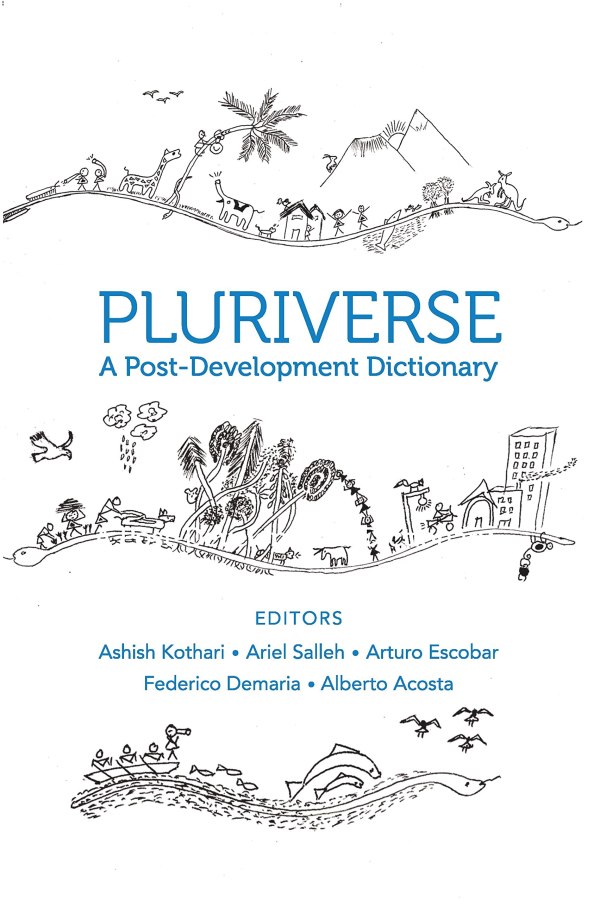
Pluriverse: A Post-Development Dictionary

Edited by Ashish Kothari, Ariel Salleh, Arturo Escobar, Federico Demaria, and Alberto Acosta

This book invites readers to join in a deep process of intellectual, emotional, ethical, and spiritual decolonization. The editors’ shared conviction is that the idea of ‘development as progress’ needs to be deconstructed to open a way for cultural alternatives that nurture and respect life on Earth. The dominant Western development model is a homogenizing construct, one that has usually been adopted by people across the world under material duress. The counter-term ‘post-development’ implies a myriad of systemic critiques and ways of living. This Dictionary is intended to re-politicize the ongoing debate over socio-ecological transformation by emphasizing its multi-dimensionality. It can be used for teaching and research; to inspire movement activists; to initiate the curious, and even those in power who no longer feel at ease with their world.

The editors are conscious of thematic and geographical gaps, but offer the book as an invitation to explore what they see as relational ‘ways of being’. This means remaking politics in a way that is deeply felt. Just so, in editing this book – as in any act of care – they themselves have encountered the limits of their own cultural reflexivity, even vulnerabilities, and in turn, discovered new understandings and acceptance. The ‘personal is political’, as feminists say. The book speaks to a worldwide confluence of economic, socio-political, cultural, and ecological visions. Each essay is written by someone who is deeply engaged with the world-view or practice described – from indigenous resisters to middle-class rebels.

The Dictionary is unconventional for its genre in having three parts. These reflect the historical transition that twenty-first century scholars and activists must work in: Development and Its Crises, Universalizing the Earth, and A People’s Pluriverse. The visions and practices contained in this Dictionary are not about applying a set of policies, instruments and indicators to exit ‘maldevelopment’. Rather, they are about recognizing the diversity of people’s views on planetary well-being and their skills in protecting it. They seek to ground human activities in the rhythms and frames of nature, respecting the interconnected materiality of all that lives. This indispensible knowledge needs to be held safe in the commons, not privatized or commodified for sale. The visions and practices offered here put buen vivir before material accumulation. They honour cooperation rather than competitiveness as the norm. They see work in pleasurable livelihoods, not ‘deadlihoods’ to escape from on weekends or ecotouristic vacations. Again, too often in the name of ‘development’, human creativity is destroyed by dull, homogenizing education systems.

They assemble this Dictionary to help in the collective search for an ecologically wise and socially just world. They envisage the book as contributing to a journey towards a Global Tapestry of Alternatives, strengthening hope and inspiration by learning from each other; strategizing advocacy and action; and building collaborative initiatives. In doing so, they do not underestimate the epistemological, political, and emotional challenges of remaking our own histories.

Read the full book here.

The Political Stakes of Cancer Epistemics

By Shagufta Bhangu, Violeta Argudo-Portal, Luiz Alves Araújo Neto, Thandeka Cochrane, Masha Denisova, Nickolas Surawy-Stepney.

The authors demonstrate a transnationally situated dialogue as a method to bring ethnographic and historical research in Brazil, East Africa (Kenya, Tanzania and Uganda), India, Russia and Spain into conversation to show three cancer epistemics sites (research, detection, and care access) where the politics of cancer epistemics are at play. First, in the field of research, they show how certain ways of knowing, and certain questions about and interests in cancer, are privileged over others. Using examples from Spain and East Africa, they highlight how a shift towards microbiological and high-technology research has outpriced many more locally grounded research agendas, ignoring questions of industrial and capital accountability in cancer aetiology. Second, they look at ways of making cancer visible, how knowledge is mobilised in cancer detection and screening, where and for whom. The authors discuss the increased individualisation of risk which is reframing cancer surveillance and therapeutic agendas. Using examples from India, Spain and Brazil, the authors demonstrate how the epistemics of cancer detection generate discourses of blame and responsibility at the individual level and accentuate existing inequities whilst simultaneously absorbing patients and their families into complex networks of surveillance. Lastly, they examine how the epistemics of cancer implicate the very possibilities of accessing cancer care, shaping care pathways and possibilities for patients. With ethnographic examples from India, Russia and Brazil, the authors demonstrate how an orientation towards the individual shifts attention away from the commercialisation of healthcare and dominance of logics of profit in therapeutics.

Read the article here.

Palestine: Spaces and Politics

By Arab Urbanism (Dena Qaddumi, Nadi Abusaada , Majd Al-Shihabi , Ammar Azzouz , Samia Henni , Lana Judeh , Faiq Mari, Aya Nassar, and Omar Jabary Salamanca).

Palestine: Spaces and Politics (PSP) is an open-access project that offers resources for education and research on Palestine’s built and natural environments through a critical lens. This initiative is a response to the growing demand for grounded academic resources on Palestine that offer depth and context beyond immediate colonial destruction. 

The PSP Introductory Curriculum positions Palestine as a complex space inhabited by people who are producers of its own knowledge, rather than a mere object on which perpetual violence is inflicted. It situates Palestine as a conceptual site to reconsider core ideas in the fields of architecture, geography, urbanism, and planning. Particularly, by foregrounding Palestinian voices and perspectives, PSP presents substantive and vivid understandings of Palestine’s past, present, and potential futures. Ultimately, the curriculum considers Palestine as imperative for analyzing the critical intersections of spaces and politics at large. 

The bilingual curriculum comprises several themes that include an opening text, key questions, key cases, and open-access readings. We also provide further readings and audiovisual material and have aimed to include resources useful for both academic and non-academic users.

Access their site here.

Are hospitals collateral damage? Assessing geospatial proximity of 2000 lb bomb detonations to hospital facilities in the Gaza Strip from October 7 to November 17, 2023

By Dennis Kunichoff, David Mills, Yara Asi, Sawsan Abdulrahim, Bram Wispelwey, Osama Tanous, A. Kayum Ahmed, Weeam Hammoudeh, Nadine Bahour, Mary T. Bassett, and P. Gregg Greenough.

After attacks in Israel led by Hamas militants on October 7, 2023, Israel launched a major military campaign in the Gaza Strip that has featured an unprecedented scale of destruction. This has included the use of highly destructive weapons in a densely populated area. Mark-84 bombs (M-84s) are 2000 lb air-dropped explosive munitions with the capacity to damage infrastructure and kill or cause severe injury hundreds of meters away. This study examines the proximity of M-84 bomb detonations to hospital infrastructure in the Gaza Strip. This article combined geospatial data on hospital locations across the Gaza Strip with maps of the locations of M-84 bomb craters between October 7 and November 17, 2023, published by CNN and New York Times. This study then measured and summarized the proximity of the bomb craters to hospitals across the territory. This article identified 592 M-84 bomb craters. Of the 36 hospitals across the Gaza Strip, 25% (n = 9) had at least one bomb crater within the lethal range (360 m) and 83.3% (n = 30) within the infrastructure damage and injury range (800 m) of their facilities. The shortest distance of a bomb crater from a hospital was 14.7 m. Two hospitals had as many as 23 and 21 bomb craters within 800 m of their facilities and one hospital had seven bomb craters within 360 m. Thirty-eight M-84 bombs were detonated within 800 m of hospitals in the Israeli military defined evacuation zone. Given the known blast effect of these M-84 bombs, the impact from the bomb detonations near hospitals likely killed and injured people in and around the hospital area, which could include civilians and hospital staff, and likely damaged hospital infrastructure. The results of this study suggest indiscriminate bombing in dangerous proximities to hospital infrastructure, which is afforded special protection under international humanitarian law (IHL)

Read the article here.

Bodies in Evidence: Race, Gender, and Science in Sexual Assault Adjudication

By Heather R. Hlavka and Sameena Mulla

For victims in sexual assault cases, trials rarely result in justice. Instead, the courts drag defendants, victims, and their friends and family through a confusing and protracted public spectacle. Along the way, forensic scientists, sexual assault nurse examiners, and police officers provide their insight and expertise, shaping the story that emerges for the judge and jury. These expert narratives intersect with the stories of victims, witnesses, and their communities to reproduce our cultural understandings of sexual violence, but too often this process results in reinscribing racial, gendered, and class inequalities.

Bodies in Evidence draws on observations of over 680 court appearances in Milwaukee County’s felony sexual assault courts, as well as interviews with judges, attorneys, forensic scientists, jurors, sexual assault nurse examiners, and victim advocates. It shows how forensic science helps to propagate public misunderstandings of sexual violence by bestowing an aura of authority to race and gender stereotypes and inequalities. Expert testimony reinforces the idea that sexual assault is physically and emotionally recognisable and always leaves material evidence. The court’s reliance on the presence of forensic evidence infuses these very familiar stereotypes and myths about sexual assault with new scientific authority.

Read the book here.

Reproductive Politics and the Making of Modern India

By Mythheli Sreenivas

Beginning in the late nineteenth century, India played a pivotal role in global conversations about population and reproduction. In Reproductive Politics and the Making of Modern India, Mytheli Sreenivas demonstrates how colonial administrators, postcolonial development experts, nationalists, eugenicists, feminists, and family planners all aimed to reform reproduction to transform both individual bodies and the body politic. Across the political spectrum, people insisted that regulating reproduction was necessary and that limiting the population was essential to economic development. This book investigates the often devastating implications of this logic, which demonised some women’s reproduction as the cause of national and planetary catastrophe.

To tell this story, Sreenivas explores debates about marriage, family, and contraception. She also demonstrates how concerns about reproduction surfaced within a range of political questions-about poverty and crises of subsistence, migration and claims of national sovereignty, normative heterosexuality and drives for economic development. Locating India at the center of transnational historical change, this book suggests that Indian developments produced the very grounds over which reproduction was called into question in the modern world.

Read the book here.

Living with Oil and Coal: Resource Politics and Militarization in Northeast India

By Dolly Kikon

Photo: Dexter Fernandes

The nineteenth-century discovery of oil in the eastern Himalayan foothills, together with the establishment of tea plantations and other extractive industries, continues to have a profound impact on life in the region. In the Indian states of Assam and Nagaland, everyday militarization, violence, and the scramble for natural resources regulate the lives of Naga, Ahom, and Adivasi people, as well as migrants from elsewhere in the region, as they struggle to find peace and work.

Anthropologist Dolly Kikon uses in-depth ethnographic accounts to address the complexity of Northeast India, a region where boundaries and borders are made, disputed, and maintained. She mainly explores the social bonds established through practices of resource extraction and the tensions these relations generate, focusing on peoples’ love for the landscape and for the state, as well as for family, friends, and neighbors. Living with Oil and Coal illuminates questions of citizenship, social justice, and environmental politics that are shared by communities worldwide.

Read the book here.

Create a website or blog at WordPress.com

Up ↑