By Shweta Rani
In this journal article, Rani unpacks the COVID-19 pandemic in the context of Delhi, its impacts on local and global scales, and how researchers prioritize between these levels.
Read the article here.
By Shweta Rani
In this journal article, Rani unpacks the COVID-19 pandemic in the context of Delhi, its impacts on local and global scales, and how researchers prioritize between these levels.
Read the article here.

By Cecilia Coale Van Hollen
As news spread that more women died from breast and cervical cancer in India than anywhere else in the world in the early twenty-first century, global public health planners accelerated efforts to prevent, screen, and treat these reproductive cancers in low-income Indian communities. Cancer and the Kali Yuga reveals that women who are the targets of these interventions in Tamil Nadu, South India, hold views about cancer causality, late diagnosis, and challenges to accessing treatment that differ from the public health discourse. Cecilia Coale Van Hollen’s critical feminist ethnography centers and amplifies the voices of Dalit Tamil women who situate cancer within the nexus of their class, caste, and gender positions. Dalit women’s narratives about their experiences with cancer present a powerful and poignant critique of the sociocultural and political-economic conditions that marginalize them and jeopardize their health and well-being in twenty-first-century India.
Read the book here.
Hosted by the London School of Hygiene & Tropical Medicine
In partnership with the UK Faculty of Public Health, the London School of Hygiene & Tropical Medicine hosted a roundtable addressing the importance of the arts and humanities within public health education and training in January 2024.
Watch the full recording here.
By David McCoy, Anuj Kapilashrami, Ramya Kumar, Emma Rhule , Rajat Khosla
Colonialism, which involves the systemic domination of lands, markets, peoples, assets, cultures or political institutions to exploit, misappropriate and extract wealth and resources, affects health in many ways. In recent years, interest has grown in the decolonization of global health with a focus on correcting power imbalances between high-income and low-income countries and on challenging ideas and values of some wealthy countries that shape the practice of global health. The authors argue that decolonization of global health must also address the relationship between global health actors and contemporary forms of colonialism, in particular the current forms of corporate and financialized colonialism that operate through globalized systems of wealth extraction and profiteering. They present a three-part agenda for action that can be taken to decolonize global health. The first part relates to the power asymmetries that exist between global health actors from high-income and historically privileged countries and their counterparts in low-income and marginalized settings. The second part concerns the colonization of the structures and systems of global health governance itself. The third part addresses how colonialism occurs through the global health system. Addressing all forms of colonialism calls for a political and economic anticolonialism as well as social decolonization aimed at ensuring greater national, racial, cultural and knowledge diversity within the structures of global health.
Read the article here.
By Bram Wispelwey, Osama Tanous, Yara Asi, Weeam Hammoudeh, and David Mills
Indigenous people suffer earlier death and more frequent and severe disease than their settler counterparts, a remarkably persistent reality over time, across settler colonized geographies, and despite their ongoing resistance to elimination. Although these health inequities are well-known, they have been impervious to comprehensive and convincing explication, let alone remediation. Settler colonial studies, a fast-growing multidisciplinary and interdisciplinary field, is a promising candidate to rectify this impasse. Settler colonialism’s relationship to health inequity is at once obvious and incompletely described, a paradox arising from epistemic coloniality and perceived analytic challenges that we address here in three parts. First, in considering settler colonialism an enduring structure rather than a past event, and by wedding this fundamental insight to the ascendant structural paradigm for understanding health inequities, a picture emerges in which this system of power serves as a foundational and ongoing configuration determining social and political mechanisms that impose on human health. Second, because modern racialization has served to solidify and maintain the hierarchies of colonial relations, settler colonialism adds explanatory power to racism’s health impacts and potential amelioration by historicizing this process for differentially racialized groups. Finally, advances in structural racism methodologies and the work of a few visionary scholars have already begun to elucidate the possibilities for a body of literature linking settler colonialism and health, illuminating future research opportunities and pathways toward the decolonization required for health equity.
Read the article here.
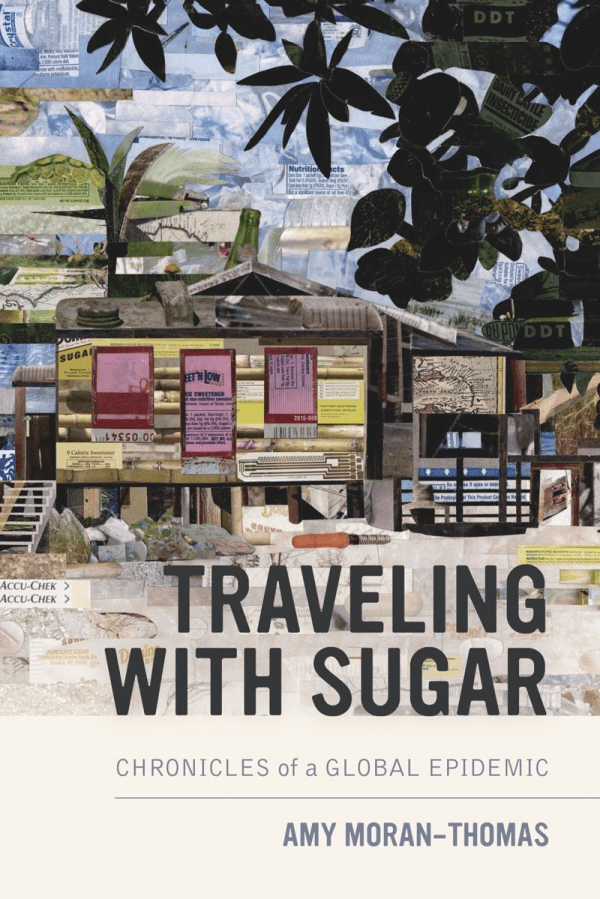
By Amy Moran-Thomas
Traveling with Sugar reframes the rising diabetes epidemic as part of a five-hundred-year-old global history of sweetness and power. Amid eerie injuries, changing bodies, amputated limbs, and untimely deaths, many people across the Caribbean and Central America simply call the affliction “sugar” -or, as some say in Belize, “traveling with sugar.” A decade in the making, this book unfolds as a series of crónicas -a word meaning both slow-moving story and slow-moving disease. It profiles the careful work of those “still fighting it” as they grapple with unequal material infrastructures and unsettling dilemmas. Facing a new incarnation of blood sugar, these individuals speak back to science and policy misrecognitions that have prematurely cast their lost limbs and deaths as normal. Their families’ arts of maintenance and repair illuminate ongoing struggles to survive and remake larger systems of food, land, technology, and medicine.
Read the book here.
By Elise A. Mitchell and Mathieu Corteel
This seminar examined two early public health interventions and their impact on the morals and ethics of the field. More particularly, Mitchell discussed the quarantining of slave ships during the Caribbean Slave Trade in the Seventeenth and Eighteenth Centuries. She argues that these policies and practices reasserted recently-arrived enslaved Africans’ apolitical status and rendered them expendable in order to preserve the health of those considered part of the colonial commonwealth.
Corteel looked at the assumptions surrounding 19th century health statistics, focusing on the normativity of public hygiene statistics on poverty before and during the 1832 cholera epidemic in Paris. Through this, he questions the moralistic emergence of public hygiene values through the lens of inequality.
Read more and watch the seminar here.
By Satrio Nindyo Istiko
In Australia, racism remains a challenge to dismantle within public health institutions. In this paper, Satrio Nindyo Istiko examines the pressures he experienced from some public health scholars and practitioners to conform to colonial and positivist approaches in knowledge production that still dominate the field. To challenge this hegemony, he aligned his research practices with what Mignolo calls “epistemic disobedience,” an approach to delink from Western ways of producing knowledge. Based on this experiential learning process, he argues epistemic disobedience should not be overlooked in the discussion of decolonizing research and antiracist pedagogy in the context of doctoral training. Through this reflection, he encourages public/global health PhD students from the Global South/Global majority to resist colonial perspectives as they navigate Western systems and cultures of producing knowledge.
Read the article here.
By Yixue Yang and Sharrona Pearl
This seminar is part of the centre for History in Public Health seminar series: Historical perspectives on ethics, morals, and values in public health. It examines the cultural and political contexts shaping historical public health interventions.
Yang explores the Protecting Students’ Eyesight Campaign in later Mao-era People’s Republic of China -1960-1976), highlighting how health guidelines transformed students’ personal habits and how the instrumentalization of youth was coated in the rhetoric of protection. Pearl discusses the history of masking and its tensions in the US, from the 19th century to Covid, emphasising the dynamics around concealing and revealing, protecting and dividing. Using a broad historical lens, she explores the history of masking, exploring various sites and domains of practice to show its consistent use as a means of protection and division.
Read more and watch the seminar here.

By Ariel Hart and Michael Lambert
Photo: Francisco Venâncio
This seminar examined the values of public health work targeting maternal and child welfare in the 20th century. Hart interrogated the social, political, and radical implications of new mid-century US public health surveillance programmes, looking at Black pregancy-related mortality and public health surveillance. Lambert considered the role of UK Medical Officers of Health in perpetrating reproductive injustice, highlighting the role of Medical Officers of Health in mid 20th century Britain.
Read more and watch the seminar here.
 Decolonising Global Health Archive
You must be logged in to post a comment.