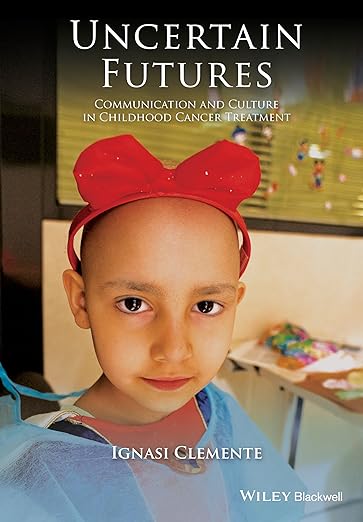
Uncertain Futures: Communication and Culture in Childhood Cancer Treatment

By Ignasi Clemente

This book examines children and young people’s attempts to participate in conversations about their own treatment throughout uncertain cancer trajectories, including the events leading up to diagnosis, treatment, remission, relapse, and cure or death. Clearly and compellingly written, Clemente relies on a new multi-layered method to identify six cancer communication strategies. This book illustrates that communication is central to how children, parents, and healthcare professionals constitute, influence, and make sense of the social worlds they inhabit—or that they want to inhabit. It provides ethnographic case studies of childhood cancer patients in Spain, using children’s own words, and examines the challenges of how to talk to and how to encourage patients’ involvement in treatment discussions. In his critique of the “telling” versus “not telling” debates, Clemente argues that communication should be adjusted to the children’s own needs, and that children’s own questions can indicate how much or little they want to be involved.

Read the book here.

The Political Stakes of Cancer Epistemics

By Shagufta Bhangu, Violeta Argudo-Portal, Luiz Alves Araújo Neto, Thandeka Cochrane, Masha Denisova, Nickolas Surawy-Stepney.

The authors demonstrate a transnationally situated dialogue as a method to bring ethnographic and historical research in Brazil, East Africa (Kenya, Tanzania and Uganda), India, Russia and Spain into conversation to show three cancer epistemics sites (research, detection, and care access) where the politics of cancer epistemics are at play. First, in the field of research, they show how certain ways of knowing, and certain questions about and interests in cancer, are privileged over others. Using examples from Spain and East Africa, they highlight how a shift towards microbiological and high-technology research has outpriced many more locally grounded research agendas, ignoring questions of industrial and capital accountability in cancer aetiology. Second, they look at ways of making cancer visible, how knowledge is mobilised in cancer detection and screening, where and for whom. The authors discuss the increased individualisation of risk which is reframing cancer surveillance and therapeutic agendas. Using examples from India, Spain and Brazil, the authors demonstrate how the epistemics of cancer detection generate discourses of blame and responsibility at the individual level and accentuate existing inequities whilst simultaneously absorbing patients and their families into complex networks of surveillance. Lastly, they examine how the epistemics of cancer implicate the very possibilities of accessing cancer care, shaping care pathways and possibilities for patients. With ethnographic examples from India, Russia and Brazil, the authors demonstrate how an orientation towards the individual shifts attention away from the commercialisation of healthcare and dominance of logics of profit in therapeutics.

Read the article here.

Create a website or blog at WordPress.com

Up ↑